
Day #1-The Mirror | “Worship God Only” | Speaker: Ps. Michelle Clarke
- Sermon By: Michelle Clarke
- Categories: The Mirror
Mirror, Mirror: 4 Surprising Truths About the “First Word” of the Ten Commandments
Have you ever sat in a room with someone you love, only to realize you are miles apart? We live in a digital-first world where we can be “connected” to a thousand things at once while remaining utterly estranged from the people—and the values—that matter most. We don’t usually intend to drift; we just get lost in the noise. We scroll, we distract ourselves, and slowly, the most important relationships in our lives begin to feel like distant memories.
This sense of disconnection is exactly why we are opening up a new series called “The Mirror.” For many of us, the Ten Commandments feel like a dusty, restrictive list of “don’ts.” But what if we looked at them differently? What if they weren’t a heavy rulebook, but a reflection—a mirror designed to reveal the character of the Divine and, in doing so, show us who we were truly meant to be?
It’s Not a Rulebook; It’s a Mirror
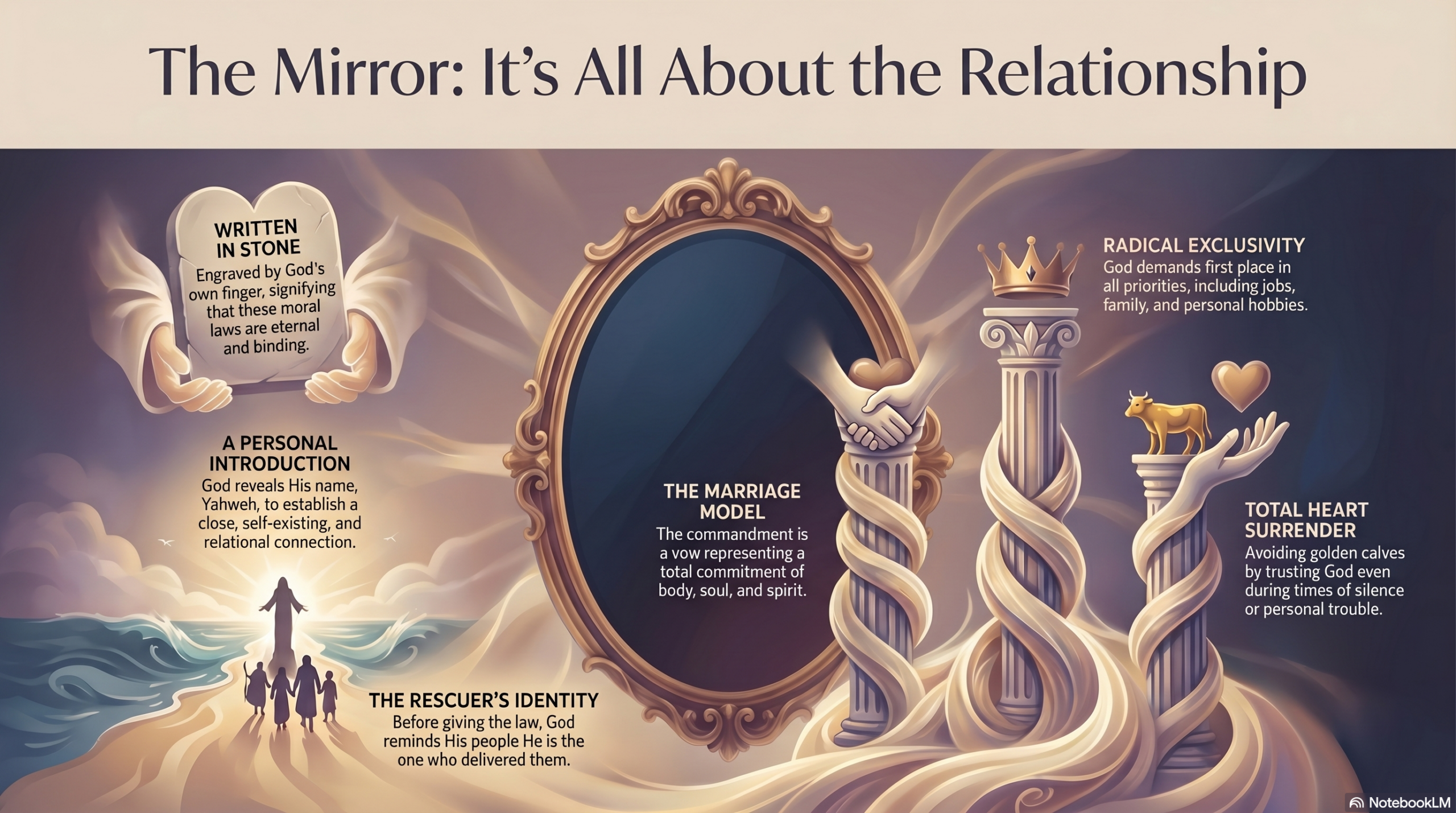
To understand the weight of these “words,” we have to look at the medium. Throughout Scripture, we see God writing in different ways for different reasons. He wrote on a wall to symbolize a coming judgment. Jesus wrote in the sand to symbolize a moment of grace. But the Ten Commandments? Those were engraved in stone with the very finger of God.
“God’s writing in stone means that these are eternal. These words, these ten words are binding.”
In the original languages, these aren’t just “laws.” In Hebrew, they are the asaret had dibrot—the “ten sayings.” In Greek, they are the deka loghe—the “ten words,” a term deeply rooted in the concept of the logos. These are more than mandates; they are the living expression of God’s nature. When we look into this mirror, we see His holiness, and that reflection inevitably reveals our own deficiencies and our desperate need for a Savior.
Takeaway #1: The Power of a Reintroduction (Yahweh)
Relationships often fail because of a lack of identity. For 430 years, the children of Israel were submerged in the culture of Egypt, surrounded by foreign gods and a worldview that sought to erase their history. By the time they reached the desert, they had effectively forgotten who God was. They were “estranged” from their own Creator.
Before God asks them to do a single thing, He reintroduces Himself. He doesn’t start with a command; He starts with a name: Yahweh. This was a revolutionary moment of intimacy. He hadn’t shared this specific name with Abraham, Isaac, or Jacob, but He shared it with a group of exhausted former slaves. By identifying Himself as the “Self-Existing One” or the “I Am,” He was moving from a distant concept to a personal Presence. He was saying, “I am the one who lifted you out of the land of Egypt. I am the one who carried you when you were too weak to walk.” Healing a broken relationship always begins with remembering who is standing in front of you.
Takeaway #2: The “Marriage Vows” of Sinai
We often view Sinai as a courtroom, but theologically, it was much more like a wedding. God wasn’t just issuing a decree; He was formally “marrying” His people. The Ten Commandments are essentially the commitment vows of that union. When the people responded, “All that the Lord has spoken we will do,” they were effectively saying “I do.”
This is the level of intimacy God desires—a concept we can think of as “into-me-you-see.” It is a total vulnerability where we stand “naked” and honest before Him, giving Him full access to our hearts. We mirror this today in our spiritual practices; just as a marriage requires constant communication and connection, our relationship with God is sustained through the 13 vows of baptism, through the “I do” of daily prayer, and through the intentionality of Bible study. It is a conscious, soul-deep decision to make the relationship work.
Takeaway #3: The Danger of the “Benched” God
The first commandment tells us to have “no other gods before me.” In the original context, that “before” means two things: in His presence and in terms of priority. We might not bow to stone statues anymore, but we have a thousand ways to marginalize God.
The speaker shared a poignant memory of playing freshman basketball. She knew she had the skills to help the team win, but her coach kept her on the bench. That feeling of being a “substitute” or an “afterthought” was so infuriating and heart-breaking that she eventually quit the team. Nobody likes to be benched—especially not the Creator of the universe.
We bench God when we pour our best energy into our jobs, our hobbies, or our screens, and give Him only the leftovers. We turn Him into a “neglected spouse” while we chase digital distractions or career milestones.
“God does not and will not share your heart. He wants an exclusive relationship, exclusive devotion, exclusive worship.”
Takeaway #4: The Vicious Cycle of the “Golden Calf”
Human nature is prone to a tragic cycle: God delivers us with a mighty hand, and yet, the moment we encounter a little silence, we panic. When Moses was on the mountain for 40 days, the silence became unbearable for the people. Because they couldn’t experience a “tangible” God in that quiet space, they reverted to their old Egyptian habits and built a golden calf.
We do the same thing today. When God seems silent or when an obstacle doesn’t move fast enough, we revert to our own “self-sufficiencies.” We take matters back into our own hands. But true surrender is the refusal to let silence dictate our faith. It is the choice to trust that even when we can’t see Him, He is Unchangeable, Unshakeable, and Unstoppable.
A Sidebar on Wholeness: The Physical and Spiritual Connection
As much as we care for your spiritual health, we must also care for your physical health. Our bodies are the vessels through which we experience this relationship. High blood pressure is often called the “silent killer” because, much like spiritual drift, it rarely shows symptoms until the damage is done.
According to the 2025 Hypertension Canada guidelines, a reading consistently at or above 130/80 is a signal that your “temple” needs attention. Just as we need a power beyond ourselves to overcome spiritual habits, we must seek God’s strength to steward our bodies. Simple acts of stewardship—avoiding excess salt to prevent fluid retention, choosing a fiber-rich diet of fruits and grains, and drinking water to naturally thin the blood—are all ways we honor the life He gave us. Victory in health and victory in spirit both require a “constant living connection” with the Divine.
Conclusion: Looking into the Mirror Today
The first commandment isn’t a threat; it’s an invitation to put first things first. When Yahweh sits at the center of our lives, the secondary and tertiary pieces—our work, our stress, our hobbies—finally begin to fall into their proper places.
This week, I want to challenge you to be mindful of your first movements. Before you allow the world to rush in, take a moment to look into the right mirror.
When you open your eyes tomorrow morning, what is the first mirror you will look into—the screen of your phone, or the reflection of your Creator?