
Sermon Title: “Good Friends” | Speaker: Pr. Wallin O’Connor
- Sermon By: Wallin O'Connor
The Giant-Slayer’s Secret: Why King David Needed More Than God to Survive His Own Mind
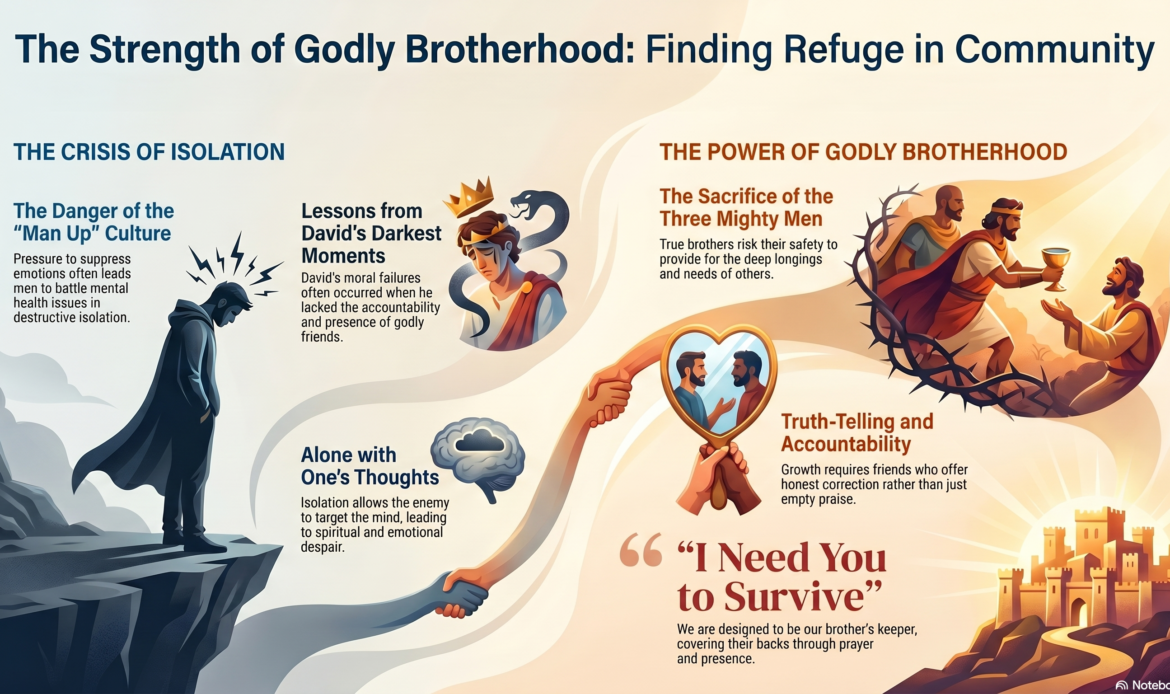
The “Man Up” Trap
I’ll be honest with you—I’ve spent most of my life following a script I didn’t write. It’s the “Man Up” manual, a rigid set of instructions handed down from infancy that equates silence with strength and stoicism with character. As someone who walks the line between theology and psychology, I see this script playing out in every counseling room and church pew. We teach our boys to swallow their tears and bury their burdens, but we don’t realize we are sentencing them to a “loneliness of the soul.”
This cultural conditioning is a trap. We tell men to just “deal with it and move on,” but we forget that even the greatest heroes of our faith were never meant to carry the weight of the world alone. To find a different way forward, we have to look at King David—not through the sanitized lens of a Sunday School felt board, but as a man who navigated deep trauma and understood that without true brotherhood, even a king will eventually self-destruct.
The Hidden Scars of the Giant-Slayer
We love to celebrate David’s victories, but we rarely acknowledge the psychological toll of his journey. Before he was a king, he was a son bypassed and forgotten. When the prophet Samuel came to Jesse’s house to anoint the future leader of Israel, David wasn’t even invited to the table.
As the pastor reflected on this omission:
“God is getting ready to anoint a new king… and you’re left in the field because your dad doesn’t recognize you anything more than a slave.”
That kind of early rejection leaves a scar. And even David’s most iconic moment—the slaying of Goliath—carried a hidden weight. While the crowds cheered, David was processing something entirely new. He had killed lions and bears to protect his sheep, but Goliath was the first time he took a human life. We ignore the potential PTSD of a young man thrust into the center of a bloody war, hunted by a jealous King Saul, and viewed with envy by his own brothers. The world wanted to celebrate the victory, but David had to regulate the trauma of a warrior’s life in a culture that offered him no place to speak his pain.
The Lethal Myth of Self-Reliance
The core of our modern men’s mental health crisis is the lethal myth that “men don’t talk.” We’ve created a culture where isolation is the default. Men stay silent about their struggles with pornography, identity crises, or professional envy, believing that confession is a sign of weakness. But the source is clear: the moment a man is alone with his own thoughts is exactly when the enemy finds a foothold for destruction.
Frankly, the church often makes this worse. We call ourselves a “hospital,” yet we treat specific moral and mental “sicknesses” as reasons for eviction rather than admission. We bury our heads in the sand, pretending these struggles don’t exist in our pews, which only forces men further into the shadows. If the church is going to be a place of healing, it must stop being a place of facades and start being a place where humanity—in all its messiness—is allowed to breathe.
The “Bethlehem Water” Test for True Friendship
In 2 Samuel 23:15-17, we see a striking portrait of David’s mental state. He was in a stronghold, and the Philistines had occupied Bethlehem. In a moment of absolute despair and longing, David sighed for a drink of water from the well of Bethlehem. This wasn’t just a craving for a specific mineral content; Bethlehem was home. He was longing for restoration, for a time before the trauma and the crowns, when he could “drink at will” without the threat of war.
Three of his men heard that longing—not as a command, but as a cry of the heart. They broke through the Philistine garrison, risking their lives for a cup of water. These were the kind of “Good Friends” every man needs: people who prioritize your mental well-being over their own safety.
True brotherhood requires an inner circle of three specific roles:
- The Intercessor: Someone who is dedicated to praying for you when you can’t find the words.
- The Protector: Someone who is committed to covering your back on the battlefield.
- The Truth-Speaker: Someone honest enough to call you out before you drift too far.
We need this because the higher you go, the lonelier it gets. As the pastor noted:
“Ministry… is one of the loneliest experiences on the planet because everybody holds you here, and the moment your humanity comes through you drop lower than the ground.”
David had 37 mighty men, but eventually, he lost his “Jonathan”—his anchor. The source notes a chilling detail: the list of his valorous men eventually dropped to 36 because David took one of them out himself—Uriah. This is the ultimate warning: a man without an inner circle to keep him human eventually becomes a danger to the very people he is supposed to lead and love.
Small Gifts, Big Hearts: The Discipline of Vulnerability
True vulnerability doesn’t just happen on the battlefield; it is built in the mundane. It’s found in the story of Kaleb, a child who bought his mother a single rose because he couldn’t afford a bouquet. To him, it was “only one flower,” but to his mother, it was a reminder of his heart. It’s the same lesson found in 1 Samuel 16:7: “For man looks at the outward appearance, but the Lord looks at the heart.”
I’ve learned that this “theology of the heart” applies even to things as small as laundry. My own “Pastor’s Socks” anecdote is more than just a funny marriage story; it’s about the discipline of vulnerability. I used to leave my socks on the floor, a habit of my own isolation, until I heard the “gentle voice” of my wife calling me back to the community of our marriage. Picking up the socks wasn’t just a chore; it was an act of acknowledging another person’s presence and peace. It was a discipline that pulled me out of my own head and back into a relationship.
Conclusion: Don’t Die Alone
The cycle of silence ends here. We were never designed to carry the weights of life in solitude, and the “Man Up” script is a path to a quiet grave. Whether you are a CEO, a pastor, a father, or a son, you need a “Jonathan.” You need an inner circle that knows your heart and will stand with you when the shadows of the valley get too long.
Don’t wait for a crisis to build these bridges. Reach out, speak up, and reject the isolation that leads to decay.
Who is the one person you can be “human” with today, and what is stopping you from reaching out?