

Sermon Title: “Enoch Walked With God” | Speakers: Nicholas Smith and Darien Manners
- Sermon By: Darian Manners, Nicholas Smith
- Categories: Adventurer's Day
The Man Who Walked Out of the World: Surprising Lessons from a 300-Year Journey
The Art of the Consistent Stroll
We live in an era defined by “short-termism.” Our internal metronomes have been recalibrated by the frantic pulse of the digital age—a world of vanishing stories, fleeting trends, and notifications that demand our immediate, though shallow, attention. In a culture that prizes the high-intensity sprint, we have largely forgotten the ancient spiritual discipline of the “walk.”
The biblical figure of Enoch offers a profound counter-narrative to our restless age. He was not a man of sudden, flashy bursts of religious fervor, nor was he a momentary hero. Instead, he was a master of the “long game.” His life suggests that the most significant human transformations do not occur in an instant of crisis, but through the quiet, deliberate movement of a soul in the same direction over the course of centuries.
The 65-Year Pivot: It’s Never Too Late to Start
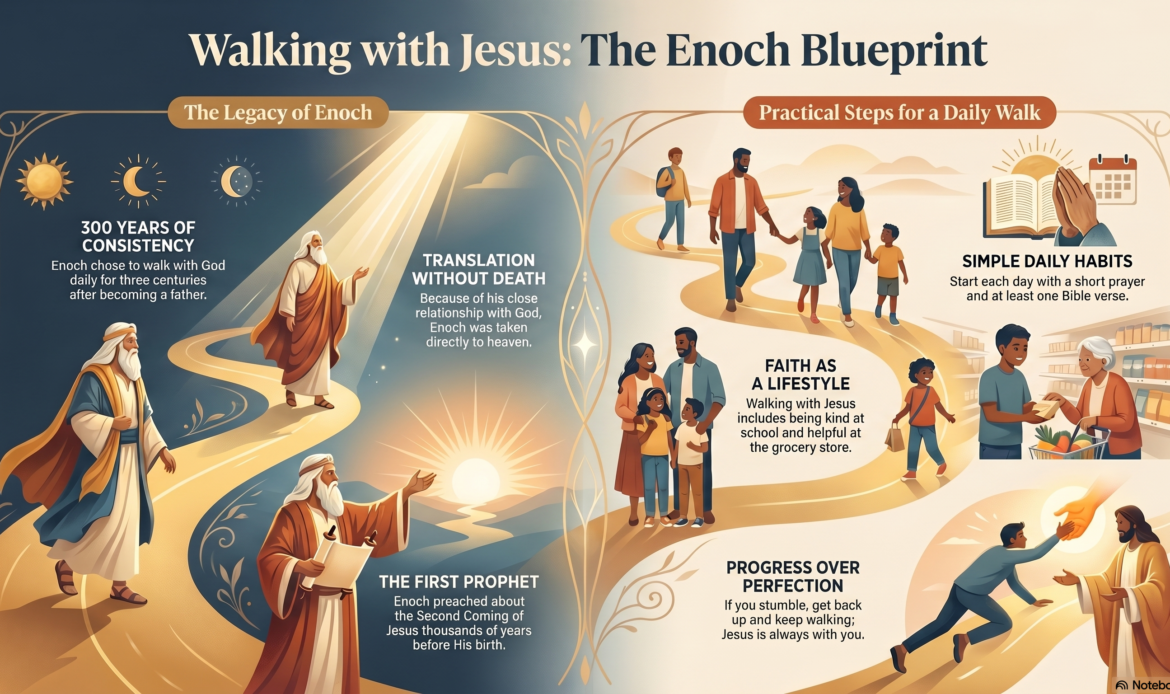
One of the most encouraging data points in Enoch’s biography is his starting line. The records indicate that Enoch did not begin his famous walk with God until he was 65 years old. This shift was triggered by a profound life event: the birth of his son, Methuselah.
Parenthood often acts as a spiritual mirror, forcing us to confront our own character as we realize we are the primary map-makers for a new life. For Enoch, this responsibility became a catalyst for a total reorientation. It is a vital reminder that a “walk with God” is rarely a trait inherited from birth; it is a conscious choice. As the source aptly notes, “It is never too early and never too late to start walking with God.”
To appreciate the gravity of Enoch’s choice, we must look at his lineage. Enoch was the great-great-great-great-grandson of Adam. He lived in an era of “living memory,” where the stories of the Garden of Eden weren’t ancient myths but eyewitness accounts passed down from a grandfather who had actually felt the soil of a perfect world. Yet, despite being so close to the beginning, the world was already drifting into wickedness. Enoch chose to swim against this tide of drift, proving that even when the world is “young” and losing its way, an individual can choose a different path.
The 300-Year Consistency: An Ontology of Habits
After his pivot at age 65, Enoch maintained his direction for 300 years. To understand this, we must look at the “ontology of habits”—the way our repeated actions eventually define our very being. In the original Hebrew, the word used for “walked” implies a repeated, ongoing, continuous action. It was not a “Sabbath-only” performance; it was a rhythmic, lifestyle connectivity.
Enoch’s spirituality existed in the mundane. In modern terms, he walked with God at the grocery store, at the park, and even while playing video games. He moved away from performative religion and toward a persistent friendship where God was a constant companion. To apply the “Enoch Method” today, we can adopt five specific, grounded steps:
- The “Good Morning” Greeting: Begin the day with a simple prayer, acknowledging God’s presence before the digital world demands your attention.
- The One-Verse Rule: Do not overwhelm yourself with dense study; focus on absorbing and reflecting on a single verse daily.
- “Real” vs. “Fake” Kindness: Move beyond polite social masks to practice genuine, internal kindness.
- The Discipline of Obedience: Recognizing that following wise guidance—much like children obeying parents—creates a smoother path for growth.
- Unprompted Goodness: Do something good that nobody makes you do, simply because it reflects the heart of the One you are walking with.
The First Prophet of the End: An Ancient Futurist
There is a fascinating paradox in Enoch’s life: he was so deeply grounded in his daily, present-moment walk that he gained a vantage point that allowed him to see further into the future than anyone of his era. While his contemporaries were trapped in the short-termism of their own desires, Enoch became an ancient futurist.
Thousands of years before the birth of Jesus, Enoch was already an evangelist for the Second Coming. The book of Jude (1:14-15) identifies him as a prophet who warned that the Lord would come with “ten thousands of his saints” to execute judgment. This suggests that consistency of character grants us a perspective that the distracted world lacks; when you walk with the Eternal, you begin to see through the lens of eternity.
The Destination Shift: The Logic of Association
The conclusion of Enoch’s life is one of the most unique accounts in human history. Genesis tells us that “he was not, for God took him.” He did not see death; instead, he was “translated.”
There is a beautiful, geographical logic to this “wild” conclusion, which we might call the Logic of Association: if you walk with someone long enough, you eventually end up where they are going. Consider the modern analogy of a best friend: if your closest companion goes to the gym every day, eventually, your own habits and destination will shift toward the gym.
Enoch’s translation wasn’t a magic trick; it was a geographical inevitability. “Your company shapes your character and your destination.” He walked so closely with God for three centuries that heaven became his natural next step. He is one of only two figures in scripture—the other being the prophet Elijah, who was taken in a chariot of fire (2 Kings 2:11)—to bypass death entirely. His life reached such a state of “lifestyle connectivity” that the border between earth and heaven simply faded away.
Conclusion: The Power of the First Step
Enoch was not a character of myth with a “perfect” life; he was a real person who led a “faithful” life. Hebrews 11:5 provides the ultimate summary of his journey: “he had this testimony, that he pleased God.” This testimony wasn’t based on a single great deed, but on the cumulative weight of 300 years of intentional steps.
His legacy is an invitation to move past the distractions of the moment and embrace the discipline of the walk. Enoch’s story proves that while we cannot control the “drift” of the world around us, we can control the direction of our next step.
If you started walking in a new direction today—choosing faith over fear and consistency over flashiness—where would you be 300 days, or even 300 years, from now? The journey of a few centuries begins exactly like yours: with a single, intentional step.