More Than a Mansion: Why Your Greatest Failures Don’t Cancel God’s Promises
1. The Universal Ache of Uncertainty: The Takeaway: Trust requires reliance, not just information.
Most of us maintain a transactional relationship with peace. We are willing to trust the process, but only after we’ve seen the blueprint. We want the “whys” and the “hows” before we commit to the journey. We live in an age defined by “troubled hearts”—hearts weighed down by the quiet panic of an unpaid mortgage, the clinical chill of a health crisis, or the nagging fear that we are simply not enough.
In her exploration of John 14, Pastor Michelle Clarke reveals a profound truth: the most famous promise of comfort in human history wasn’t a standalone greeting. It was a lifeline thrown to a man in the middle of a total personal collapse. We often read about the “many mansions” at funerals, but the promise was actually forged in the fire of an impending failure. It was a response to the reality that sometimes, the person we are most afraid of failing is ourselves.
2. The Promise Was Born in the Shadow of Failure: The Takeaway: Divine assurance often arrives at our moment of greatest weakness.
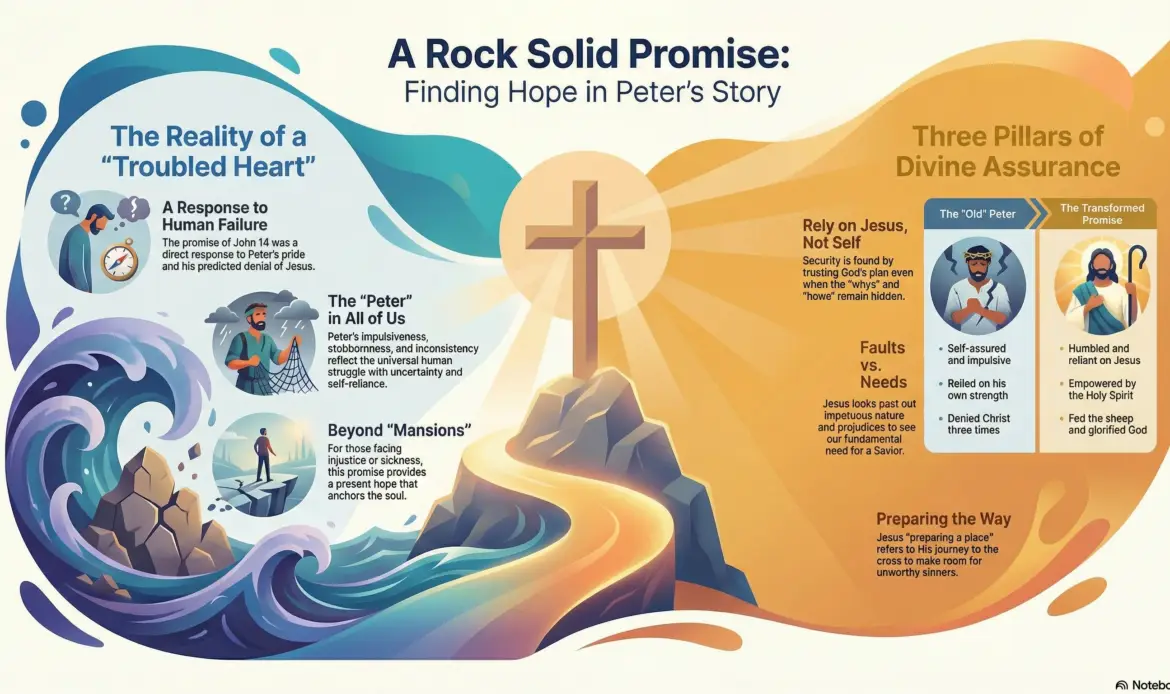
It is easy to sanitize the words “Let not your heart be troubled.” We treat them as a gentle platitude, but in the Upper Room, they were a direct response to a crushing prophecy. Jesus had just “burst the bubble” of the Apostle Peter’s ego. When Peter, in his characteristic arrogance, insisted he would lay down his life for Christ, Jesus didn’t offer a pat on the back. He offered a reality check.
“Verily, verily, I say unto thee, The cock shall not crow, till thou hast denied me thrice.”
The insight here is staggering: the promise of the Father’s house follows immediately after the prediction of Peter’s greatest shame. The “verily, verily” emphasis signals a divine truth that the promise isn’t for the perfect—it’s for the self-deluded. Our “Rock Solid” assurance doesn’t depend on our performance; it is given precisely when our self-reliance is proven to be hollow.
3. Jesus Sees the Need, Not Just the Fault: The Takeaway: Our flaws do not disqualify us from being needed by the Divine.
Consider Peter: a man who brought a knife to a prayer meeting and a foul mouth to the Messiah’s side. He was impulsive, headstrong, and inconsistent. He was a bigot with a bad temper who frequently thought he knew better than his Master. If you were building a religious board of directors, Peter wouldn’t even make the short list.
Yet, the Divine economy works differently. Jesus didn’t seek out the polished elite of the Sanhedrin; He chose “common-ass fishermen” and known troublemakers. He looked past the external chaos to find the internal desperation.
“He looks past our faults and he sees our needs.”
For anyone today feeling disqualified by their own contentiousness or prejudice, the message is clear: your faults are the very reason the “place” was prepared. You aren’t just tolerated; you are needed.
4. “Preparing a Place” is About a Cross, Not Just Real Estate: The Takeaway: The “room” God makes for us was bought by sacrifice, not just construction.
We often get lost in the imagery of celestial architecture, but the Greek term eto meopon—meaning “to make ready” or “make room”—points to something far more visceral than a construction project. In this context, “going to prepare a place” is synonymous with the journey to the Cross.
The “room” Jesus made for us is a legal standing. By going to Calvary, He opened a door that our failures had slammed shut. He was making room for the unworthy and the undeserving in a kingdom that holiness would otherwise forbid them from entering. The promise is “rock solid” because its foundation isn’t gold or jasper; it is anchored in the sacrifice that Peter (and we) could never earn.
5. The Great Reversal: From Denial to Restoration: The Takeaway: Maturity and restoration follow the surrender of our pride.
Peter’s journey is a masterclass in the “Afterwards.” In the Upper Room, Jesus told him, “Where I am going, you cannot follow me now.” Peter wasn’t ready; he was still trying to follow Jesus through the strength of his own will. The promise wasn’t canceled by his denial; it was simply paused until he reached the end of himself.
The man who once wept in the darkness after the cock crowed eventually became the man who requested to be crucified upside down, feeling unworthy to die upright like his Lord. The “self-empowerment” of the young fisherman had to die so the “total reliance” of the Apostle could be born. His failure wasn’t a dead end; it was the prerequisite for his restoration.
6. The Divine Waiter: A Different Kind of Kingdom: The Takeaway: True power is found in the Creator’s willingness to serve His creation.
To ground this promise in reality, we have to look at the “real deal” feast awaiting us. This isn’t a misty, metaphorical afterlife. The vision is tactile: a table longer than human measurement, placeholders made of diamond, and goblets of transparent jasper. The canopy is littered with stars, and the tablecloth is spun with a silk that no created being could produce. There are even East Indian mangoes—perfect and blemish-free.
But the most radical detail is the host. Consider an earthly leader like Mark Carney; he isn’t coming to your house to cut your birthday cake. Yet, the Creator of the universe is depicted as the “Divine Waiter.”
“Seated at the head of the table are three thrones—one for the Father, one for the Son, and one for the Holy Spirit… but the one who created the universe will serve you and me in the kingdom made new.”
True kingdom power is expressed not through being served, but through the Creator personally serving his children their portion.
7. Conclusion: The Question of Surrender
The “Rock Solid Promise” is not a reward for the self-sufficient; it is a provision for the broken. Our security doesn’t come from our ability to dodge the blows of life, but from the Protector who stands in front of us.
As the theologian Ellen G. White once wrote, the Father’s presence encircled Christ, and nothing could touch Him unless infinite love permitted it for the blessing of the world. That same circle of protection is available to us.
“Nothing can touch [the believer] except by our Lord’s permission… our life is in God’s hands—the safest, most secure place to be.”
As you navigate your own uncertainty today, ask yourself: Which “trouble” are you currently trying to carry alone through self-reliance, rather than trusting it to the One who has already made room for you? You don’t need to be perfect to sit at the table; you just need to be willing to let Him serve you.