
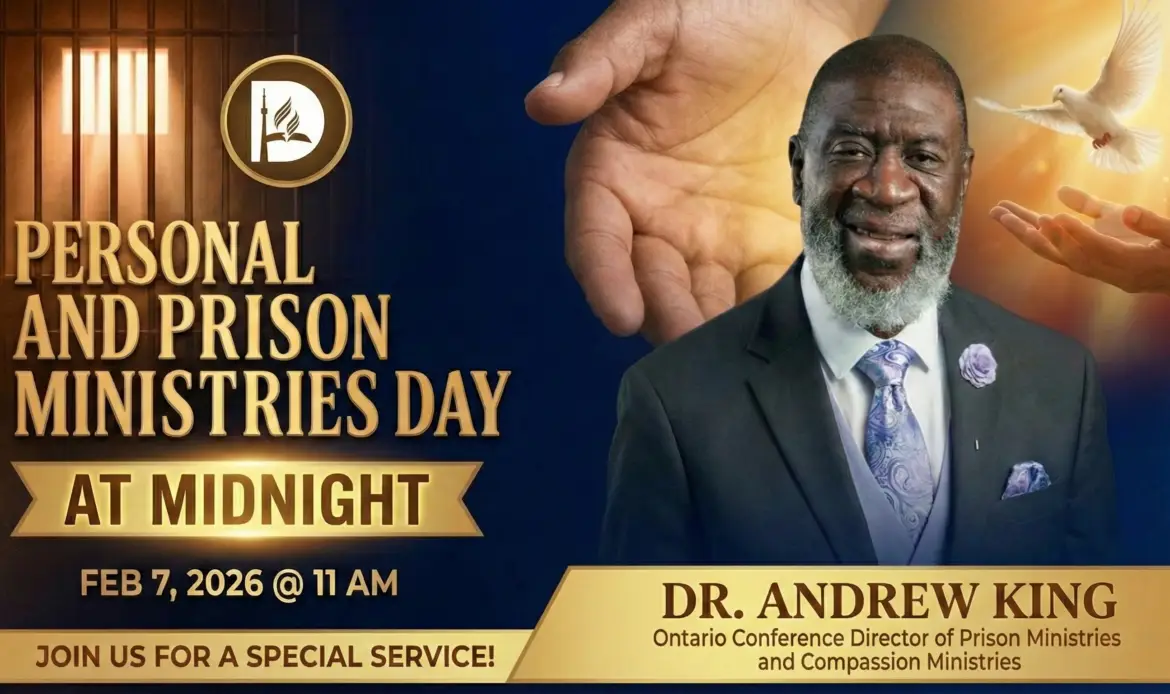
At Midnight
- Sermon By: Andrew King
The Hurricane and the Hymn: Why Your Midnight is a Gateway, Not a Cage
1. The Hook: Finding Light When the Foundations Shake
We often speak of “midnight” as a mere chronological marker, but in the landscape of the human soul, midnight is a climate. It is that heavy, suffocating moment when the foundations of your life begin to tremble—whether through a sudden loss, a systemic injustice, or the quiet erosion of hope. It is the hour when the “inner prison” feels most restrictive and the darkness most absolute.
Yet, if we look closer at the narratives that shape our resilience, we discover a profound truth: these moments are rarely just obstacles. They are often “divine appointments,” specifically designed to facilitate a radical transformation. When the sun goes down and the doors are locked, we aren’t just waiting for morning; we are being invited to a shift in perspective that turns a dead end into a point of departure.
2. The Power of the “Midnight Song”
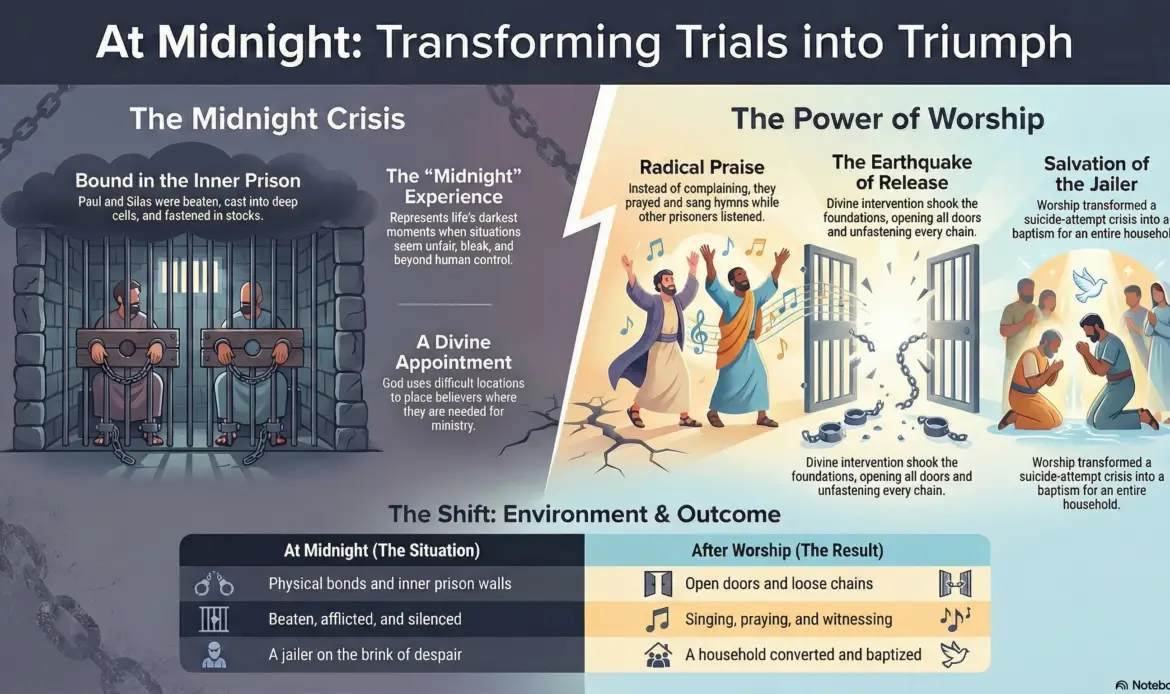
The story of Paul and Silas begins with a “Macedonian call”—a vision of a man pleading for help that led them into the heart of ministry. However, that divine direction led them straight into a beating and a jail cell. They weren’t just in prison; they were thrust into the “inner prison,” the deepest, most isolated sub-basement of their circumstances.
What followed was counter-intuitive to the human ego. Instead of nursing their wounds or questioning their calling, they chose to pray and sing hymns. This was not a private retreat; it was a public witness. The source tells us that “the prisoners were listening.” When we find the courage to worship at our lowest point, we change the atmosphere for everyone within earshot. Our reaction to trouble becomes a form of “prison ministry” to a world that is watching to see if our faith can survive the dark.
“Suddenly there was a great earthquake, the foundations of the prison were shaken; immediately all the doors were opened and everyone’s bonds were unfastened.”
3. Resilience Lessons from the “Hurricane”
In the spirit of Black History Month—celebrated recently with the vibrant energy of “Wakanda gear” and the “Black History Anthem”—we look to the story of Ruben “Hurricane” Carter. A top-ranked boxing contender, Carter’s life was derailed in 1966 by a wrongful conviction for a triple homicide. He spent 19 years behind bars, a “midnight” that lasted nearly two decades.
The catalyst for his freedom was as surprising as the earthquake in Philippi. It wasn’t just a legal team; it was a grassroots, multi-ethnic effort spearheaded by Lesra Martin, a Brooklyn teen living in Canada, and a group of his friends. This diverse coalition of “white brethren and sisterin” reminds us that justice is a communal labor. Carter eventually moved to Toronto, became a citizen, and served as the executive director for Innocence and Justice. His enduring advice to the next generation remains a cornerstone of resilience: “Make sure you don’t let your problems define you.”
4. Gateways, Not Fences: Reimagining the Rules
In our spiritual journey, we often view the Ten Commandments as a series of restrictive fences—ten laws of what we cannot do. But within the “Man in the Mirror” series, a different framework emerges. These aren’t just rules; they are reflections of who we are meant to become.
When we shift from a “restrictive” mindset to a “possibility” mindset, the commandments transform from fences into ten gateways of what we can do. They provide the structure that allows true freedom to flourish. By seeing these laws as gateways, we stop focusing on the limitations of the cell and start focusing on the expansion of our character.
5. Service as DNA: The Legacy of Practical Love
The true measure of a community’s heart is found in its “Practical Ministry.” Consider the legacy of “Sister Denny,” a woman whose very DNA was service. Even as she faced her own final “midnight,” she was meticulously planning a prison ministry program and envisioning a reintegration center.
This vision is now becoming a reality at the Bentworth Community Service Center near Yorkdale Mall. By converting this space into a reintegration center, the community aims to serve the 1,500 inmates released annually in Ontario. This is “evangelism as community service”—the understanding that a warm blanket or a grocery bag speaks louder than a flyer.
“People don’t care how much you know until they know how much you care.”
6. The “A Little is Much” Philosophy
Impact is rarely a byproduct of abundance; it is a result of stewardship. Take, for example, the Downsview Seventh-day Adventist Church’s 2025 budget. Despite a 40% shortfall—collecting only $183,000 against a $336,000 goal—the congregation didn’t retreat.
Instead, they managed to fix their building, support their local school, and provide relief to hurricane victims in Jamaica and the Philippines following Hurricane Melissa and a super typhoon. This is the “Master’s hands” philosophy: when we have the “free will” to place our limited resources into the divine, a “divine multiplication” occurs. A shortfall in the ledger does not mean a shortfall in the mission.
7. Conclusion: Becoming a Worshipper in the Dark
Whether we are facing a literal hurricane or the metaphorical “midnight” of a wrongful conviction or financial lack, the call remains the same: “Get off your seat, stand up, and make a difference.” Our struggles are not just cages; they are the stages upon which we find our voices.
We must decide if we will be defined by our problems or by our response to them. As you stand in your own hour of darkness, consider this: Is your current struggle a prison, or is it the stage for the song that will set someone else free? Don’t just survive your midnight—worship through it.