

Go Wash and Be Clean
- Sermon By: Kenute Cornwall
Beyond the Surface: 4 Surprising Lessons on Healing and the “Scratch-Scratch” of Life
We live in a culture obsessed with the aesthetic of perfection. We meticulously curate our public identities, polishing our professional reputations until they gleam like medals on a uniform. But beneath the surface of the successful career or the high-end “LinkedIn” lifestyle, many of us carry a “but”—a secret flaw or a persistent sorrow that we hope the world never notices.
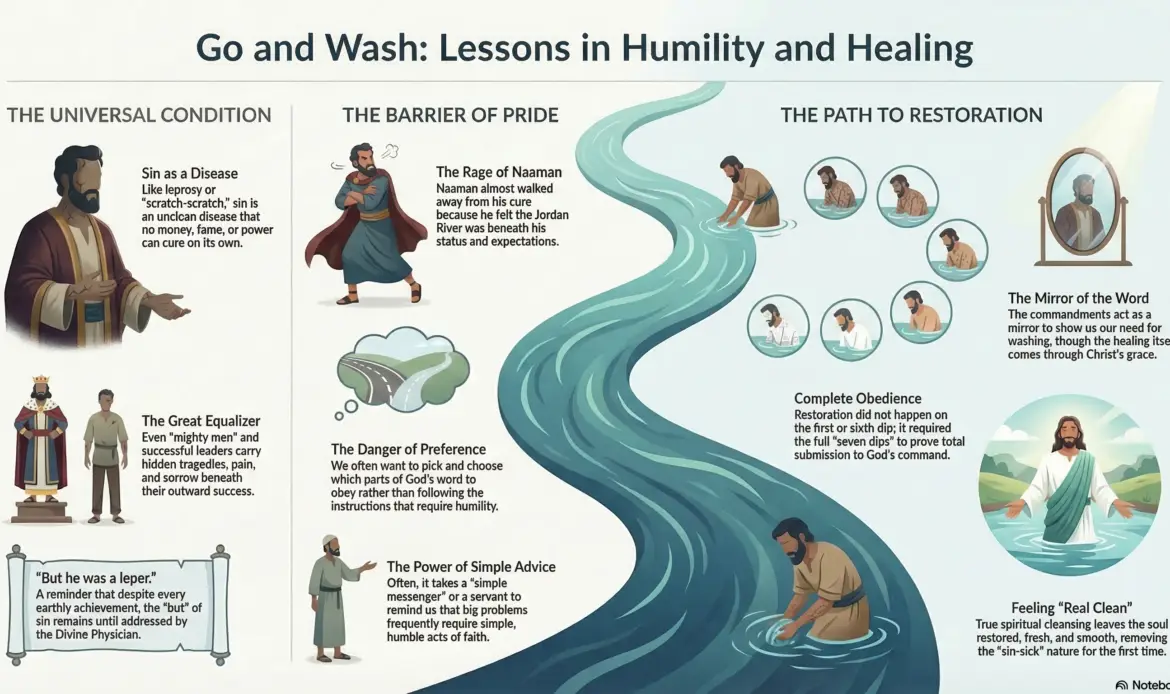
This human condition is archetypally captured in the narrative of Naaman. He was a captain of the host, a “mighty man of valor,” and highly honorable in the eyes of his king. He had every marker of external victory, but he was a leper. That single word, “but,” served as the invisible wall between his public prestige and his private agony.
The “But” Syndrome (Success is Not a Shield)
We have commodified peace, attempting to buy a “money salvation” that our bank accounts were never designed to provide. We often use our achievements as a decorative jacket to cover wounds that are deeper than any tailor can reach. We assume that if we are prosperous enough, we can bypass the tragedy that exists beneath the suit.
The reality is that Naaman’s medals and his proximity to power could not provide a cure for his skin. His success was undeniable, yet it was ultimately insufficient for his deepest necessity. Even the “mighty men of valor” among us carry the weight of brokenness that no promotion can resolve.
“He was a very successful man, yes. But beneath under that jacket, under that suit, tragedy, pain, and sorrow, comes along.”
Modern life is a performance where we prioritize the “jacket” over the man wearing it. We spend our lives defending a successful image while the “leprosy” of soul-deep sorrow eats away at our joy. Healing begins only when we admit that our prestige is not a shield against our pain.
The “Scratch-Scratch” vs. The “Zest” Slogan
Emergency Newsflash: We all possess an unclean disease and a sinful body that no modern product can fix. In the late 1970s, a skin condition colloquially known as “scratch-scratch” plagued communities, driving people to seek relief in humble, pungent remedies. They used “Carbolic soap,” Bitter Bush, Aloe Vera, and Nettle mixed with salt—solutions that were unrefined but effective.
Contrast this with the corporate marketing of the era, such as the “Zest” soap campaign that promised: “For the first time in your life, you’re going to feel real clean.” We are often quick to buy the most expensive, beautifully packaged products because we believe price equals efficacy. We want a “shiny” cure for a “dirty” problem, favoring the slogan over the substance.
The world’s marketing offers a temporary feeling of cleanliness that never reaches the internal “sin-sick” condition. To be “real clean” requires the “regeneration” that the Divine Physician offers, rather than the surface-level scrub of a premium bar of soap. We must stop trying to solve spiritual “scratch-scratch” with corporate aesthetics.
The Pride of the River (The Stigma of Isolation)
Leprosy, much like the recent COVID-19 pandemic, creates a profound sense of isolation and stigma. It forces the “great man” into the shadows, making him an outcast who must warn others to stay away. Naaman’s healing required him to confront a humiliating reality: the solution was beneath his social standing.
When he arrived at the prophet Elisha’s home, the prophet didn’t even come out to greet him, sending a simple messenger instead. Naaman was told to wash in the Jordan—a river he viewed as a “dirty” basin filled with bugs and worms. He raged, preferring the prestigious, clear waters of Damascus, the Abana and Pharpar.
- The Abana & Pharpar: Represent the “high-status” solutions we think we deserve.
- The Jordan: Represents the “humble” path we often reject because it offends our ego.
Pride tells us that a simple solution is an insult to our complexity. However, “simple people have great messages,” and we cannot “choose or pick” which parts of the truth we follow based on our status. Healing requires us to step down from our chariots and into the mud.
The Power is in the Seventh Dip (The Anatomy of a Floater)
Breakthroughs are rarely the result of partial effort; they are the reward for absolute obedience. Naaman’s journey into the Jordan was a grueling test of faith where the middle stages looked exactly like failure. He had to submerge himself completely, over and over, while his pride screamed at him to stop.
- Dips 1 through 6: Zero visible change. Naaman would “pop up like a floater,” looking at his hands only to see the same diseased skin.
- Dip 7: The moment of total restoration. Only after the final act of surrender did his flesh become like that of a small child.
You cannot keep a part of the law and expect the full blessing of the remedy. Many of us quit at the sixth dip, frustrated that our efforts haven’t yielded immediate “Instagram-ready” results. True transformation happens when we finish the process, even when the first six attempts leave us looking exactly the same.
Conclusion: A Measureless Remedy
The journey from disease to restoration is not actually about the “river” at all; it is about the measureless nature of the remedy. The love required to heal our “buts” and our “tragedies” is a love that would “drain the ocean dry” if the sea were filled with ink and every blade of grass were a quill. It is a love that reaches from the highest star to the lowest depths of our personal hells.
What is the “dirty river” you are refusing to step into today? Perhaps your pride says you deserve a more prestigious cure or a more sophisticated Savior. But real life—clean, restored, and vibrant—waits for you the moment you stop defending your “jacket” and start following the simple, transformative directions of the Divine Physician.