Just One Body
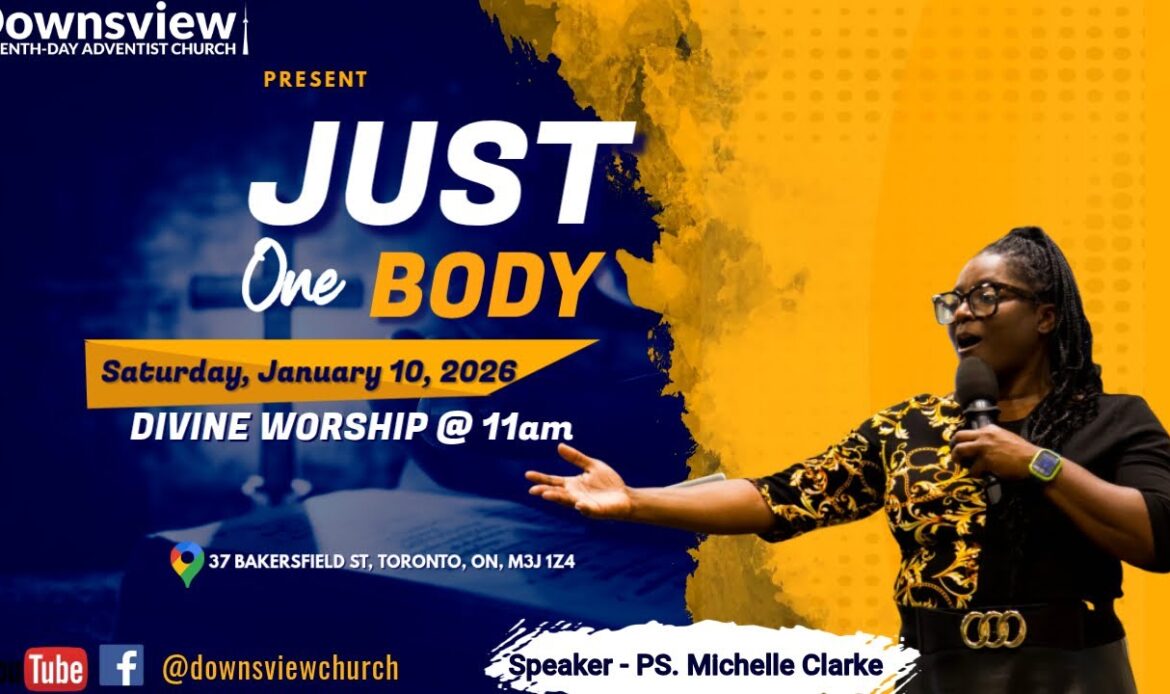
- Sermon By: Michelle Clarke
Sermon Outline: Just One Body
Speaker: Pastor Michelle Clarke
Date: January 10, 2026
Primary Text: 1 Corinthians 12:12-27
Theological Focus: Ecclesiology, Pneumology, and Christian Unity
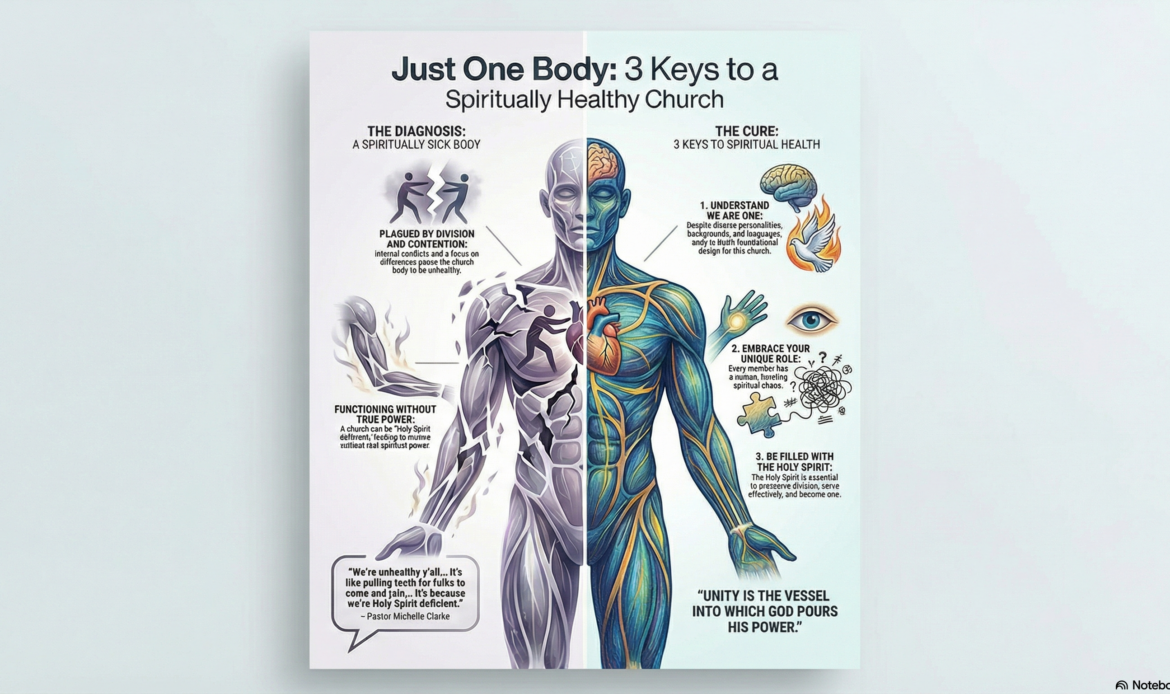
Executive Summary: This sermon utilizes the biological metaphor of the human body, as presented by the Apostle Paul, to diagnose spiritual sickness within the modern church. Pastor Clarke argues that congregational health is contingent upon three factors: acknowledging ontological unity, embracing diverse vocational roles, and receiving the indwelling of the Holy Spirit.
I. Introduction: The Biological Metaphor and Ecclesiology
- A. The Interdependence of Biological Systems
- 1. The sermon opens with a personal narrative regarding a naturopathic diagnosis, establishing the premise that human beings are “given just one body” to steward [1], [2].
- 2. Scientific Analogy: The human body is a complex organism composed of trillions of cells. These cellular groups (e.g., heart, liver) are mutually interdependent; the failure of one organ leads to systemic failure [3], [4].
- B. Theological Transition to the Church
- 1. Paul applies this biological reality to the church, designating it as the “Body of Christ” [4].
- 2. Refutation of Individualism: The sermon critiques the “just me and Jesus” theology, arguing that detachment from the community indicates a sick body [5], [6]. Individual salvation does not negate corporate responsibility.
II. Contextual Analysis: The Church at Corinth
- A. The Condition of the Corinthian Church
- 1. The church is identified as “carnal” and “worldly,” characterized by division and contention rather than spiritual maturity [7].
- 2. Sectarianism: Members divided themselves based on loyalty to human leaders (Apollos, Peter, Paul) rather than Christ [7].
- B. Cultural and Doctrinal Challenges
- 1. Corinth was a “melting pot” of Greek and Roman philosophies, influencing the church’s ethics [8], [9].
- 2. Theological Errors: The church struggled with sexual immorality, a dualistic view of the body/spirit, and a chaotic approach to spiritual gifts (specifically the prioritization of tongues) [9], [10].
- 3. The Primary Deficit: The overarching failure of the Corinthian church was a lack of love [10].
III. Theological Imperative 1: The Ontological Unity of the Church
- A. The Priority of Oneness
- 1. Biblical Basis: John 17:20-22. Jesus’ High Priestly Prayer establishes unity as the primary apologetic for the world to believe in the Sender [11], [12].
- 2. The Trinitarian Model: Unity in the church reflects the “co-eternal persons of the Godhead” who move as one in purpose and mission [12].
- B. Unity in Diversity
- 1. The church comprises diverse socioeconomic statuses, cultures, and personalities (“Unity in diversity”) [12].
- 2. Application: Despite differences in language or background, the members must function as a single entity to ensure survival and health [13].
IV. Theological Imperative 2: Vocation and Functionality
- A. Embracing Divinely Appointed Roles
- 1. Biblical Basis: 1 Corinthians 12:15-20. The foot cannot reject its role because it is not a hand; the ear cannot reject its role because it is not an eye [14].
- 2. Sovereignty of Assignment: God arranges the members of the body “just as He pleased” [15].
- B. The Danger of Comparison and Envy
- 1. Members are warned against coveting gifts they do not possess (e.g., singing, hospitality, or leadership) [15].
- 2. The Symphony Analogy: The church is likened to a symphony where different instruments (gifts) play under one conductor (Christ). Harmony requires distinct, not identical, contributions [16].
- 3. Selfish ambition renders the body spiritually inept; unselfish service creates health [17].
V. Theological Imperative 3: Pneumological Empowerment
- A. The Necessity of the Holy Spirit
- 1. Biblical Basis: 1 Corinthians 12:13. Baptism into one body is accomplished only “by one Spirit” [17].
- 2. The sermon identifies the Holy Spirit as the “neglected” member of the Godhead in modern practice [18].
- B. Eschatological Urgency
- 1. Early vs. Latter Rain: Drawing on Adventist theology, the “early rain” (daily filling) is a prerequisite for the “latter rain” (end-time power/Time of Trouble) [18].
- 2. Reference: Ellen White is cited regarding the danger of neglecting spiritual preparation, leaving believers without shelter in the day of the Lord [18], [19].
- 3. The Wait: Just as the disciples waited for the Spirit in Acts before witnessing, the modern church cannot function effectively without this power [19], [20].
VI. Diagnostic Application and Conclusion
- A. Spiritual Diagnosis: “Holy Spirit Deficiency”
- 1. Symptoms of this deficiency include gossip, holding grudges, and empty pews [21].
- 2. The Critique of Piety: High religious performance (prayer, ceremony) without love is diagnosed as a showcase rather than true godliness [22].
- B. The Cure: The Fruit of the Spirit
- 1. True filling of the Spirit manifests as love (1 Corinthians 13)—patience, lack of envy, and loyalty [22], [23].
- 2. The Formula for Power: “Unity is the vessel into which God pours His power.” The outpouring of the Spirit in Acts occurred only when the disciples resolved their differences [23].
- C. Call to Action
- 1. A call for members to be “restored, renewed, recommitted” for the year 2026 [24], [25].
- 2. Corporate prayer for the removal of “malfunction” caused by malice, pride, and greed [25].