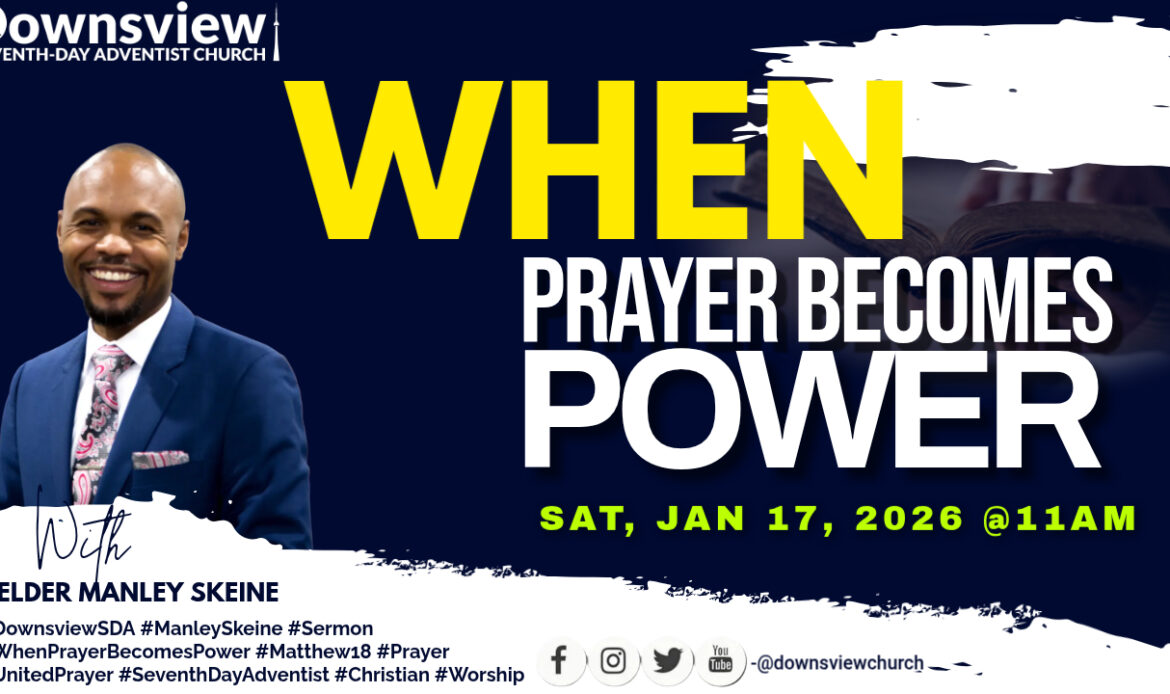
When Prayer Becomes Power
- Sermon By: Manley Skeine
Beyond the Pews: 5 Surprising Insights on Power, Prayer, and Living with Purpose
We live in a world that glorifies the hustle, the loud protest, and the packed stadium. But what if real power operates in the quiet moments, the small gatherings, and the leftover fragments of our lives? A recent sermon by Elder Manley Skeine at Downsview Seventh-day Adventist Church offers a refreshing, and at times counter-intuitive, look at how we connect with the divine in a chaotic year.
Whether you consider yourself deeply religious or simply spiritually curious, the concepts of “Jesus in the Mix” offer a fascinating framework for navigating modern stress. Here are the five most impactful takeaways that might just change how you approach your daily grind.
1. Jesus the Saver: Generosity Doesn’t Mean Waste
We often think of divine power as a source of unlimited abundance—a fountain that never runs dry. While that may be true, there is a surprising lesson in economy found in the miracle of the loaves and fishes. Elder Skeine points out that Jesus was the epitome of generosity, creating a meal for over 5,000 people out of thin air.
However, the counter-intuitive twist is what happened after the miracle. Even though Jesus had the power to create infinite food, He wasn’t wasteful; He commanded the disciples to collect the leftovers so that nothing was lost. This suggests a profound mindfulness about resources. It challenges us to look at our own lives—our homes, cars, and lifestyles—where we often spend carelessly simply because we have been blessed. The lesson is clear: true gratitude involves stewardship, not just consumption.
“Jesus saves 12 baskets of scraps right after proving that he could instantaneously provide so much food that wasting 12,000 baskets wouldn’t have been an issue.”
2. The Power of “Two or Three”
In an era of influencers and viral metrics, we are conditioned to believe that “big” equals “important.” We look for full pews and crowded rooms to validate an experience. Yet, the source material reminds us that spiritual presence is not a numbers game. The scripture emphasizes that where only two or three are gathered in His name, the Divine is present in their midst.
This is a liberating concept for anyone who feels small or isolated. You don’t need a megachurch or a massive conference to tap into spiritual power. God does not wait for the room to be full to show up. The intimacy of a small group—or even a partnership—is enough to trigger a divine connection.
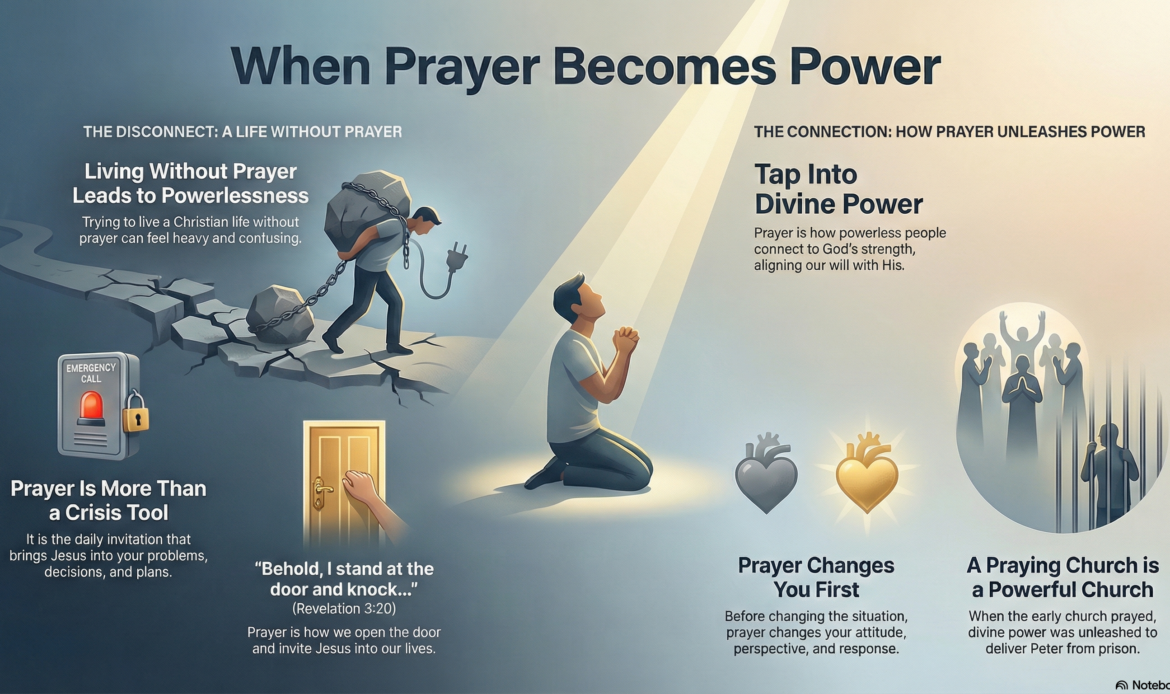
3. Prayer is an Invitation, Not a Crisis Hotline
Many of us treat prayer like a fire extinguisher: we only grab it when there is an emergency. We rush through our mornings and days, only to call on God when things fall apart. Elder Skeine argues for a different approach called “Jesus in the Mix”.
Prayer isn’t just a ritual before meals; it is the specific invitation that brings the divine into our decision-making, our conflicts, and our planning. It is the mechanism that aligns our will with a higher power. If we want to navigate a chaotic year successfully, we can’t afford to rush out the door without first establishing that connection.
“Prayer is not just talking about God; prayer is talking with God.”
4. The Psychology of Surrender: Changing the Pray-er
Here is perhaps the most psychologically astute point of the message: we often pray to change our external circumstances, but prayer usually changes us first. It is easy to fall into the trap of telling God exactly how to fix our lives, but we often don’t even know what is best for us.
When we pray with thanksgiving, the immediate result isn’t always a magical fix to the problem, but a shift in perspective. It brings a “peace that surpasses all understanding” which guards the mind. Prayer may not immediately alter the situation, but it fundamentally alters your attitude and response to it, providing strength when emotions are weak.
5. The Ultimate Protest is Spiritual
The sermon recounts the story of Peter, who was imprisoned by a government that wanted to silence the church. In a modern context, our instinct might be to organize a protest, demand justice, or leverage social media. Surprisingly, the text notes that the church did not organize a protest or hold up placards.
Instead, the church went into “panic” mode—but a specific kind of panic that led to organized prayer. The result was a supernatural intervention where chains fell off and gates opened of their own accord. This suggests that there is a form of activism that happens on one’s knees—a power that can dismantle obstacles and “unlock gates” that human effort alone cannot budge. When a community aligns in this way, “obstacles yield to miracles”.
A Final Thought
As we look toward the rest of the year, the invitation is to move from a life of frantic effort to one of powered alignment. Whether it is managing our finances with the mindfulness of the “leftover fragments” or finding peace in a small circle of two or three, the message is that the Divine is waiting to be invited into the mix.
The question you have to answer is this: Are you trying to live your life and simply fitting God into the gaps, or are you willing to let prayer be the center around which everything else revolves?