
Day #8-The Mirror | “Do not Steal” | Speaker: Ps. Wallin O’Connor
- Sermon By: Wallin O'Connor
- Categories: The Mirror
Beyond the Hand in the Cookie Jar: 5 Radical Truths About the 8th Commandment
1. The Mirror of Four Simple Words
“Thou Shalt Not Steal.”
On the surface, it is perhaps the most uncomplicated directive in the Decalogue. We read it and instinctively look for the “hand in the cookie jar”—the petty theft, the shoplifting, the obvious embezzlement. We assume that as long as we aren’t snatching purses, we are standing on the right side of the law.
But as Pastor Wallin O’Connor explores in “The Mirror” series, these four words serve as a high-definition reflection of our internal landscape. This commandment is far more than a prohibition against taking physical objects; it is a complex framework for property, human dignity, and the implicit trust required for a functional society. To look into this commandment is to confront the tension between our ego’s desire for ownership and God’s requirement for stewardship. It is a radical call for the reclamation of our humanity from a world that treats people like chattel.
2. Ganav: The Stealth of Deceptive Acquisition
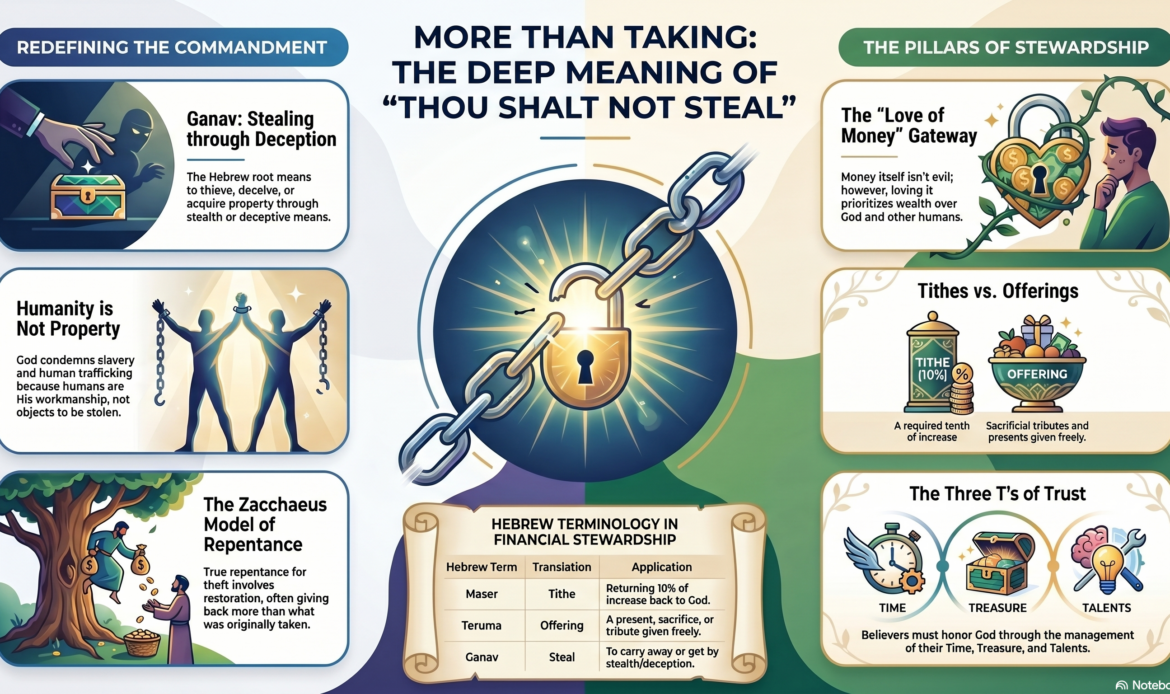
To grasp the weight of the 8th commandment, we must look at the linguistic precision of the original Hebrew. The word used for “steal” is Ganav. Though it is spelled “Ganab,” it is pronounced with a sharp ‘v’ sound, and its implications go far beyond a simple grab-and-go.
Ganav implies thievery through deception—the act of “carrying away secretly” or “getting by stealth.” It suggests that the core of theft is not merely the loss of property, but the breach of honesty.
“Ganav means to literally to thief or by implication to deceive, to carry away, to secretly bring, to steal, to get by stealth or to acquire deceptively.”
When we move through the world with a “stealth” mindset—cutting corners in business, offering a dishonest contract, or failing to give a full day’s work for a full day’s pay—we are practicing institutionalized Ganav. This commandment acts as a mirror, showing us that when we acquire deceptively, we aren’t just taking an object; we are destroying the foundational bond of truth that holds our community together.
3. The Modern “Slave Factory” and Systemic Theft
The ultimate form of theft is the theft of a human being. Pastor O’Connor argues that God “has not and will never condone slavery.” Whether through historical chattel slavery or modern-day kidnapping and human trafficking, treating a person as property is the supreme violation of the 8th commandment. Why? Because the Bible declares that the earth and its inhabitants are “God’s workmanship.” If man did not create us, man has no right to own us.
In a first-world context, this theft is often more subtle but no less devastating. O’Connor reflects on a “slave factory” mentality where the economy is “designed to make permanent slaves.” He points to the irony of a nation like Canada, rich in resources, being held hostage by market pressures and geopolitical conflicts like those in the Strait of Hormuz.
This is theft on a systemic scale. When we treat humans as replaceable parts in an economic machine, we steal their divine dignity. We attempt to own what God has already claimed as His own.
4. The “Borrowed Possession” Parenting Model
Perhaps the most counter-intuitive wisdom found in this commandment is the dismantling of parental “ownership.” In a world that views children as extensions of the parent’s ego, O’Connor proposes a radical alternative: children are borrowed possessions.
If we do not “own” our children, our role shifts from owner to steward. This necessitates a community-wide vigilance. O’Connor illustrates this with the “Brother Bruce” anecdote: while playing as a youth, a village elder named Brother Bruce noticed misbehavior. When the boys talked back, Brother Bruce “drew his belt like it was Excalibur coming out of its sheath” to provide discipline.
This wasn’t an overreach; it was the “guard” stepping in when the “warden” (the father) wasn’t around. When we view children as borrowed from God, we realize we are responsible for protecting them from the “thieves” of the world who seek to destroy their character.
“Our children are only borrowed possessions and we are responsible for them. We cannot allow someone, a thief in the world, to come and sneak, snatch them and destroy them.”
5. Mammon: The Gateway of Institutionalized Greed
A common spiritual misconception is that money itself is evil. The 8th commandment, however, clarifies that the currency isn’t the culprit—the love of it is. The love of money is the “gateway” or “root” of all kinds of evil because it forces us to prioritize Mammon over people.
This creates a culture of righteous indignation. Consider the modern CEO who claims there is “no money for raises” or employee benefits, yet accepts a million-dollar bonus at year’s end. This is a form of theft that has been normalized. When wealth becomes the primary motivator, people become obstacles to be stepped on rather than neighbors to be loved. In the pursuit of Mammon, we steal the livelihoods and peace of others to secure a false sense of safety.
6. The Math of Faith: Testing the Windows of Heaven
How do we break the cycle of scarcity that leads to theft? O’Connor shares the “Sardine and Rice Principle.” His mother once had only one small pot of rice and two tins of sardines to feed a family of four. Yet, she invited four extra people from church to dinner.
Young Wallin did the “math of scarcity”—he knew the portions didn’t add up. But his mother understood Maser (the tithe) and Teruma—the idea of an offering or a tribute given as a sacrifice. She prayed, and the food multiplied; eight people ate and were satisfied. This is the Math of Faith. It is a move from a scarcity mindset to an abundance mindset through trust in divine provision.
“Try me in this… Prove me. Challenge me. God, I can’t pay my rent. Trust me.”
By returning what belongs to God, we “test” His promise to provide. When we stop trying to “own” everything, we open ourselves up to a miracle that the world’s math simply cannot explain.
Conclusion: Numbering Your Days vs. Your Days Being Numbered
The 8th commandment is ultimately an invitation to stop living in fear. There is a profound psychological divide between living as if your “days are numbered” and “numbering your days.”
To live as if your days are numbered is to live in doom, gloom, and a desperate need to hoard and steal to survive. But to number your days is to count your blessings—recognizing that every breath, every talent, and every cent is a gift. It is the shift from the ego of ownership to the peace of stewardship.
As you look into the mirror of this commandment, ask yourself: “Are you robbing yourself of a miracle because you’re too busy trying to own what was only ever meant to be borrowed?”