
Day #6-The Mirror | “You Shall Not Murder” | Speaker: Ps. Wallin O’Connor
- Sermon By: Wallin O'Connor
- Categories: The Mirror
The Silent Murder: Why Your Words Might Be More Lethal Than You Think
1. Introduction: The Mirror of the Decalogue
Most of us approach the Ten Commandments with a comfortable sense of moral distance, particularly the sixth: “Thou shalt not murder.” We relegate this law to the realm of the “criminal”—the violent offender or the societal outlier. However, within the heart of our community here in Downsview, we must confront a more unsettling reality. The Decalogue is not a distant legal code for the few; it is a spiritual mirror for the many. When we look deeply into its surface, we discover that the desecration of life often begins long before a hand is ever raised in violence. It begins in the quiet chambers of the heart and the casual conversations of the sanctuary.
2. Takeaway #1: The Linguistic Shift—Kill vs. Murder
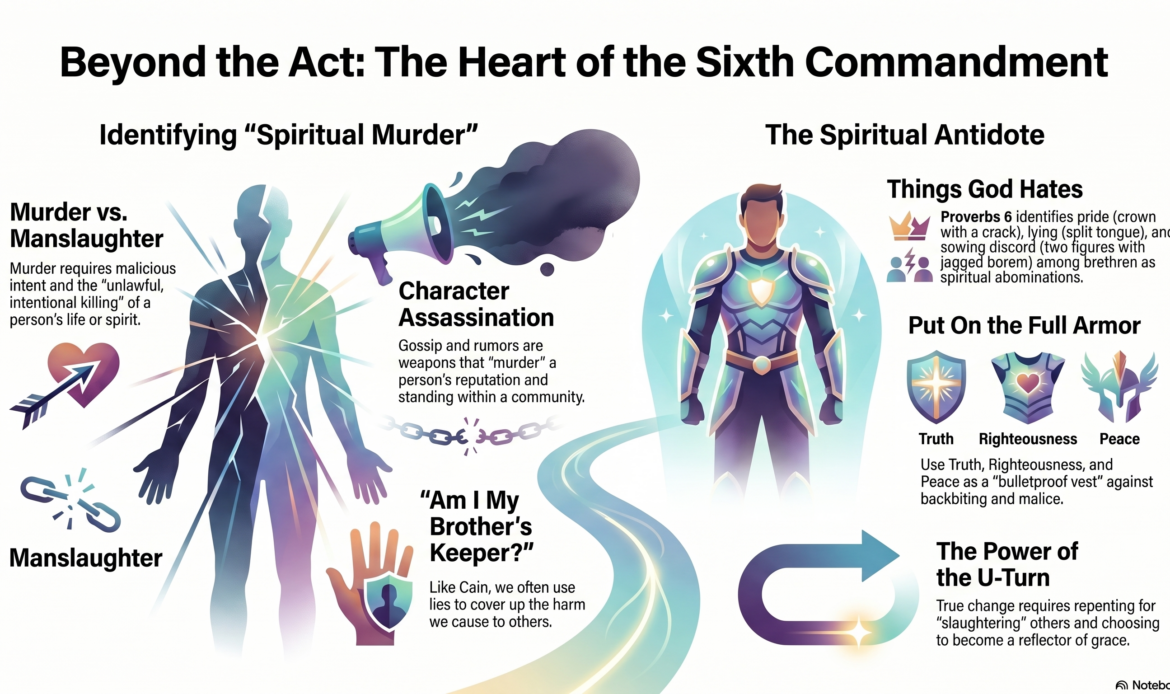
To understand the ethical weight of this commandment, we must look to the original Hebrew. The word used is ratza, which does not apply to all forms of killing, but specifically denotes the unlawful, intentional slaying of another. In the eyes of the Divine, the defining factor in spiritual culpability is intent.
To illustrate the gravity of motive, consider the metaphor of a staircase:
- Manslaughter (The Accident): If you are walking down the stairs and accidentally trip, causing someone else to fall and lose their life, it is a tragedy born of human frailty.
- Murder (The Intent): If, however, you have quarreled with that person and, as they walk ahead of you, you place a foot in their back, the intent transforms the fall into a murderous act.
The commandment calls us to look past our outward behavior and scrutinize the hidden motives that drive our interactions.
3. Takeaway #2: The Modern Sniper—Character Assassination
The most lethal weapon in modern society is not found in a holster, but in the mouth. As a community ethicist, I have witnessed the carnage of “character assassination”—the systematic destruction of a person’s reputation through gossip and idle talk. In my twenty years of ministry, pastoring seventeen different churches, I have found that gossip is the number one problem in every single one.
This is not harmless chatter; it is visceral warfare. Too often, individuals sit in our services “loading up their weapon,” gathering fragments of rumors and waiting for the break in service to “fire” upon their neighbors. This weaponized gossip kills a person’s standing, their influence, and their spirit. As we navigate the slippery slope of social sins, we must remember:
“Sin takes you further than you want to go, stays longer than you want to stay, and costs you more than you can ever pay.”
4. Takeaway #3: The Seven Things God Hates
The ethical gravity of our social conduct is reinforced in Proverbs 6:16-19. Here, the writer lists seven “abominations”—things the Divine does not merely dislike, but hates. It is a sobering realization that social discord is categorized alongside the shedding of blood.
- A proud look: Defined specifically as “abnormal arrogance.”
- A lying tongue: The desecration of truth.
- Hands that shed innocent blood: Physical murder.
- A heart that devises wicked plans: Intentional malice.
- Feet swift to run to evil: An eagerness for wrongdoing.
- A false witness: Malicious deception against a neighbor.
- One who sows discord among brethren: The destruction of community unity.
Sowing discord is a form of communal murder; it severs the life-giving bonds that hold a body of people together.
5. Takeaway #4: Holistic Holiness—The Circulation of Life
Holistic holiness teaches us that the physical and spiritual are one. Just as our bodies are the “Temple of the Holy Spirit,” our physical health is a reflection of our stewardship. There is a profound parallel between our bodies and our community: just as “blockages” in our arteries (plaque and hardening) stop the flow of life-giving blood, the blockages of pride and discord stop the flow of communal peace.
Signs of Poor Circulation (The Physical Blockage):
- Numbness or tingling (pins and needles) in the extremities.
- Cold fingers or toes and skin discoloration (pale or blue tones).
- Muscle pain, weakness, or bulging veins.
To combat these blockages, we must prioritize exercise, hydration, and the elevation of our limbs. Nature also provides a remedy in the form of Burdock Root—a vegetable long used for its medicinal properties. It acts by widening blood vessels and purging toxins, allowing life to flow freely again.
Burdock Root Tea Remedy:
- Ingredients: 2 to 3 dry Burdock roots (sliced thinly and dried until crisp), 2 cups of water, honey/lemon to taste.
- Process: Boil the water, add the slices, and steep for 10–15 minutes.
- Benefit: Rich in antioxidants, it protects the vessels from damage and restores overall circulation.
6. Takeaway #5: The Bulletproof Solution—The Armor of God
To survive the “sniping” of the world and the murderous impulses of our own hearts, we must clothe ourselves in spiritual protection. Ephesians 6 provides a framework for this defense, which is only effective when viewed through the lens of Jesus:
- Truth (The Belt): The foundation that holds our integrity together.
- Righteousness (The Breastplate): Protecting our heart and motives.
- Peace (The Shoes): Explicitly found in the “Prince of Peace,” giving us the stability to move through conflict without becoming part of it.
- Faith (The Shield): Used to quench the “fiery darts” of backbiting and name-calling.
- Salvation (The Helmet): Safeguarding our thoughts and perspectives.
Note well that this armor provides no protection for the back. This implies that as we move forward in holiness, God protects the areas we cannot see. There are no “backbiters” in the presence of the Divine; when we advance in grace, God guards what we have left behind.
7. Conclusion: The Power of the U-Turn
Ancient law provided a “City of Refuge” for the manslayer—a sanctuary where an individual could flee from the “Avenger of Blood” and await a just judgment. This was more than a legal loophole; it was a literal matter of life and death, requiring a total “U-turn” in direction and behavior.
Today, we are called to create a similar sanctuary. Repentance requires the honesty to admit when our words have “taken someone out.” We must move from being a community of snipers to a community of refuge. As you evaluate your interactions this week, ask yourself the most demanding question of all: Are you a sanctuary for your neighbor, or a sniper on the wall?