
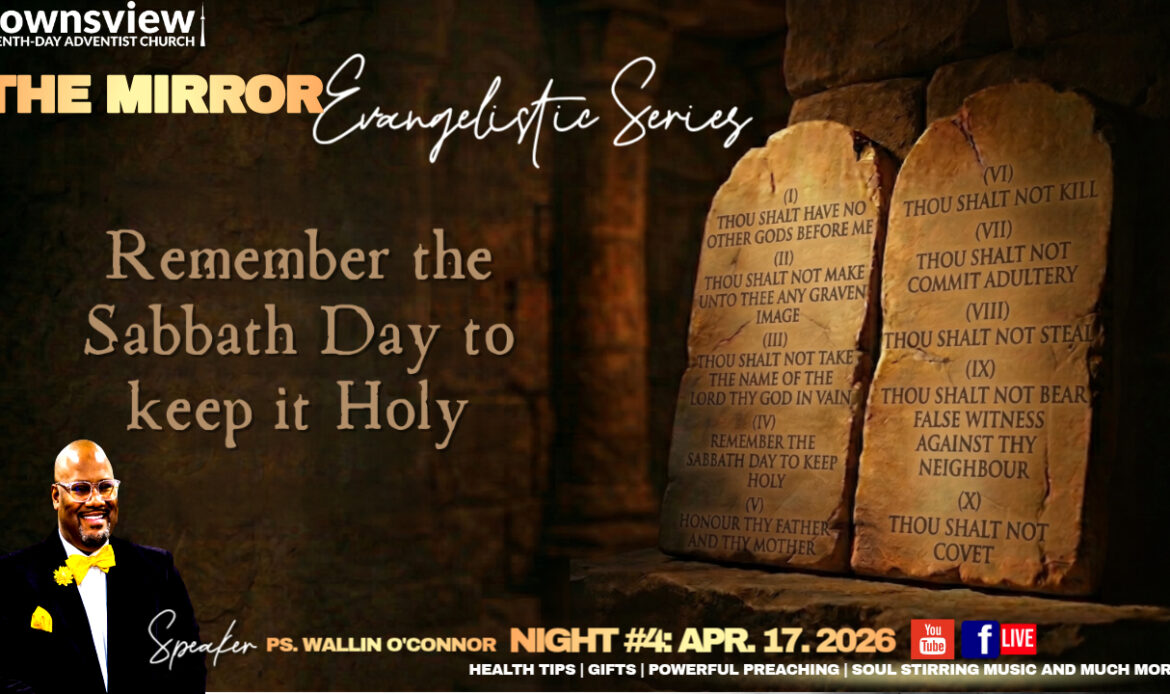
Day #4-The Mirror | “Remember The Sabbath Day To Keep It Holy” | Speaker: Ps. Wallin O’Connor
- Sermon By: Wallin O'Connor
- Categories: The Mirror
More Than a Day Off: 5 Surprising Truths About the Sabbath You Might Have Missed
We live in a culture that worships the “hustle.” From the first alarm to the late-night blue light of our screens, the pressure to produce and perform can feel like a never-ending cycle. Many of us are living in what Pastor Wallin O’Connor calls a “spiritual Egypt”—a state of exhaustion where we have become slaves to our routines and the demands of modern life. We are tired to the bone, not just physically, but spiritually.
Pastor O’Connor recalls his time in Alberta, a place where the sun refuses to set until 10:30 at night. For a “city boy” used to the standard rhythms of life, the constant light felt like madness. It wasn’t until he stepped away into the wilderness, into a “quiet zone” away from the cars and cell phones, that his spirit finally lifted. He found that true rest requires more than a nap; it requires a “coming away” period to hear God’s voice.
But there is a secret hidden in the middle of the Ten Commandments—a “bridge” that most of us are crossing without ever looking down. The Sabbath is not merely a tradition; it is a divine intervention for the weary soul. Here are five surprising truths that will change how you view your day of rest.
1. The Sabbath is the Strategic Pivot of Your Spiritual Life
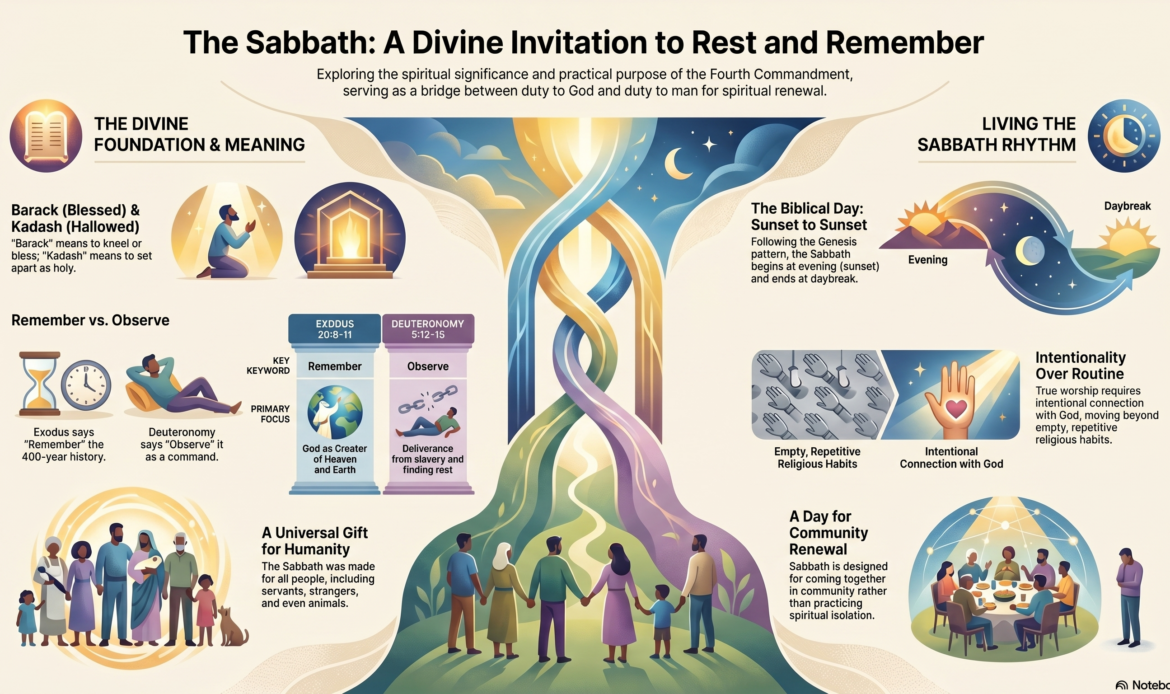
The fourth commandment isn’t just another item on a list of “thou shalt nots.” It holds a unique position as the midway point and culmination of the entire Decalogue. The Ten Commandments are structured with a specific, intentional flow: the first four focus on our vertical relationship—our homage and devotion to God. The final six focus on our horizontal relationship—how we show love and respect to our fellow human beings.
The Sabbath is the bridge between the two. It is the transition point that prepares our hearts to move from worshiping the Creator to rightly loving His creation. If you cannot find the discipline to honor God’s time, you will lack the spiritual grounding necessary to honor your neighbors. The Sabbath is an invitation to a decision: will you prioritize the vertical so that you have the capacity for the horizontal?
2. From “Remembering” to “Observing”
There is a fascinating linguistic shift between the two primary accounts of the Ten Commandments. In Exodus 20, God says, “Remember.” In Deuteronomy 5, He says, “Observe.” This isn’t an accident. After 400 years of Egyptian slavery, the Israelites had neglected God’s commands and forgotten the rhythm of rest. God told them to “Remember” because the practice had been lost. By the time they reached Deuteronomy, they were told to “Observe”—to move from mental acknowledgment to active, disciplined practice.
To understand the depth of this practice, we must look at two Hebrew terms: Barack and Kadash. Barack means “to bless” or “to kneel.” While God doesn’t kneel to anyone, He “bows down” to this day by placing a unique blessing upon it. Kadash means “to hallow” or “set apart.” It is a consecration of time. “Remembering” is a mental act, but “observing” is the active shaping of your life around these consecrated hours. True spiritual growth happens when the truth moves from your head to your hands.
3. Sincerity Is No Substitute for Obedience
We often hear the sentiment that as long as we are sincere, the “how” of our worship doesn’t matter. But the story of Cain and Abel warns us otherwise. Cain offered the “fruit of the ground”—the very best of his hard work. Yet, his offering was rejected because it didn’t line up with God’s specific instructions. Sincerity is vital, but it cannot replace the sacrifice of obedience.
In our modern context, this is a call to stop trying to “worship God my way.” Even those who claim to keep the Sabbath often break it by “stockpiling” religious work. We fill the day with so many meetings and “holy” chores that we end the day more exhausted than we began. God does not accept worship that ignores His specific command for rest. If we fill the Sabbath with the work we neglected during the first six days, we are missing the “coming apart” that God requires.
4. The “Blueberry Muffin” Logic: Identity Over Labels
Many people get lost in the names of the days or the changes in modern calendars. Pastor O’Connor uses the “Blueberry Muffin” analogy to clear the confusion: you can change the name of the muffin or the label on the box, but the ingredients and the identity remain the same.
Mankind has messed with the labels—naming days after celestial bodies and shifting the start of the day to midnight. However, God’s “recipe” for time is defined as “evening and morning.” Regardless of what a human calendar calls a day, the weekly cycle established at Creation—the Seventh Day—remains unchanged. When we return to the “evening and morning” rhythm, we align ourselves with the original design of the universe, gaining a mental and spiritual clarity that man-made cycles can never provide.
5. Breaking the Silo: Why Community Is Non-Negotiable
The Sabbath was never intended for isolation. While personal reflection is necessary, the commandment calls for a “holy convocation”—a coming together. There is a danger in the “silo.” In nature, wolves look for the individual that has strayed from the pack to pick them off. Spiritual isolation makes you vulnerable to the enemy.
You might feel that community is difficult, but as the saying goes, “teeth and tongue must meet.” Friction is a natural part of being a family, but we were designed for togetherness, not isolated worship. We are stronger, safer, and more encouraged when we worship as a collective body. As the old truth goes, “A family that prays together stays together.”
The Refreshment You’ve Been Waiting For
The Sabbath is a perpetual covenant—a sign of worship between God and humanity that exists forever. It is not a burden; it is a gift designed for your benefit. When you truly “come apart” from the world, you experience a refreshing of the soul that no vacation or cruise can provide.
Are you ready to stop “stockpiling work” on your day of rest? Are you tired of being a slave to a routine that never ends? The invitation is open. Stop being a slave to spiritual Egypt and choose to enter the rest that God has hallowed for you. Will you make the decision to observe it?