

Sermon Title: “Belonging To God” | Speaker: Bro. Quevawne Gordon
- Sermon By: Quevawne Gordon
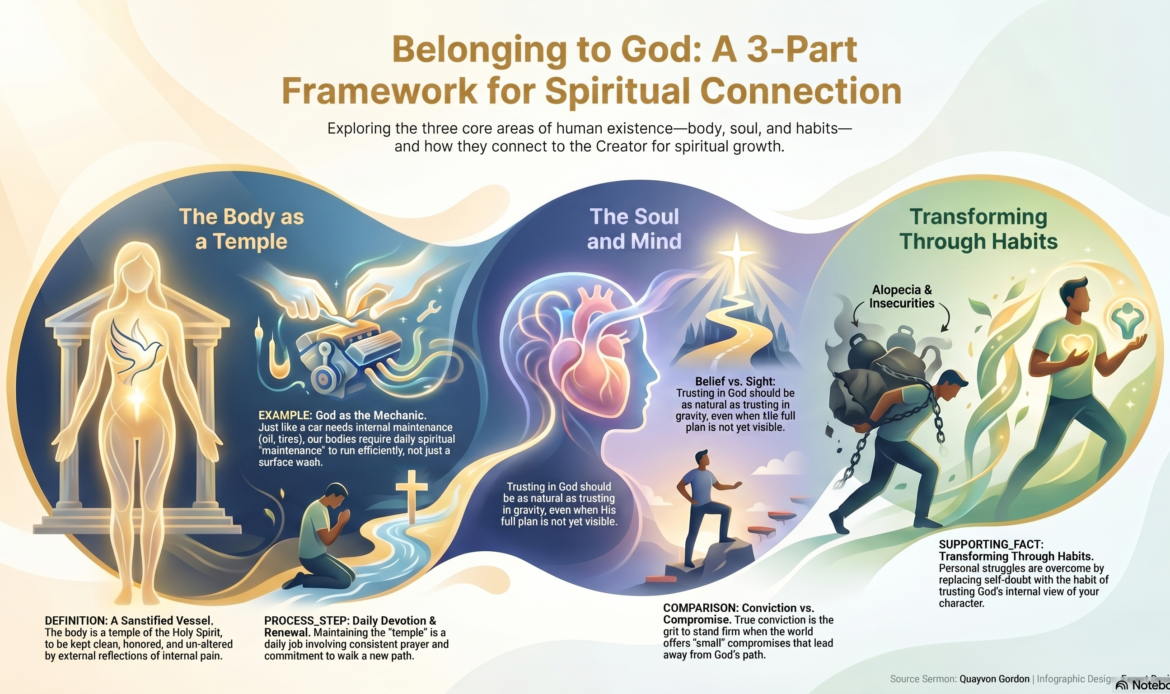
Beyond the Pews: 5 Unconventional Lessons on Truly Belonging to God
1. Introduction: The Search for Real Connection
The dead do not know they are dead. They know nothing. We, however, wake up every morning with the heavy privilege of consciousness, yet we often take the very act of breathing for granted. We assume that because we woke up yesterday, today is a guaranteed sequel. Within this fragile existence, there is a universal human ache—a desperate, often unspoken desire to belong to something larger than our own reflection.
Often, we look for this connection in the pews of a church, assuming that “belonging” is a static label we earn by showing up. But belonging to God is not a passive membership; it is a comprehensive, three-dimensional lifestyle. It is the synchronization of the body, the soul, and the habits we cultivate in the dark. It is a journey beyond the sanctuary, requiring us to move past the surface and into a relationship that demands rigorous maintenance and total vulnerability.
2. Your Body is a Honda Civic (And God is the Mechanic)
Think of your physical form as a silver Honda Civic. It’s reliable, it gets you where you need to go, and it was designed with a specific purpose. Many of us spend our lives “polishing the outside.” we buy the right suits, wear the most elegant dresses, and ensure our outward appearance is spick and span for the Saturday service. But a car doesn’t run on its wax job.
If your gearbox is grinding, your brake pads are worn thin, or you haven’t had an oil change in years, a shiny hood won’t save you when the engine stalls. True “temple maintenance” is internal. We are made of dust, but while we inhabit these forms, we are not our own. We have to be willing to pull into the garage and let the Creator look under the hood.
“God is our mechanic, and we have to go to him when we’re running… you may go to him with something broken and come out brand new, if not better.”
Maintenance isn’t a one-time fix. It’s the realization that if we don’t allow the Mechanic to check our internal friction, we will eventually be halted to a stop by the very world we are trying to navigate.
3. The “Peeled Pepperoni” Trap: The Danger of Small Compromises
The erosion of a soul rarely begins with a grand rebellion. Instead, it starts at the back door with a friend and a pizza box. Imagine you have a conviction, a line you’ve drawn in the sand about what you will and won’t consume. Then a friend—someone you like, someone who seems harmless—offers you a slice of pepperoni pizza. When you hesitate, they say, “It’s okay, I’ll just peel it off for you.”
The danger here isn’t overt evil; it’s the comfort of friendship masking the compromise of identity. The devil doesn’t always use a full-frontal attack; he uses the influence of those who don’t share your conviction to encourage a “halfway” belonging. By saying “I’ll just peel it off,” you begin a cycle. Eventually, you forget why the line was there in the first place. True belonging requires being firm on the other side of the line, recognizing that small, “minuscule” compromises are the quickest way to lose your way.
4. Vulnerability is a Power Move
For years, I hid behind a “habit of lying” born from deep insecurity. Since middle school, I have lived with Alopecia. In the early days, when patches began to appear like craters on the moon, I was terrified of being seen. When friends asked why my hair looked the way it did, I’d tell them my brother shaved my head in my sleep because I beat him in a game of 2K. I spun a web of stories to avoid the reality I couldn’t confront.
I spent years praying for a “miracle cure,” spritzing my head with the pungent aroma of rosemary, lavender, and thyme, hoping for a sprout. But the breakthrough didn’t come when my hair grew back; it came when my prayer shifted. I stopped asking for a change in my appearance and started asking for a “sound mind” to weather the storm.
“Tears are not for the weak. They’re for the strong. It’s okay to cry. It’s okay to be sad. Everything has its season.”
Vulnerability is not a sign of defeat. It is the prerequisite for peace. Acknowledging our “patches” allows us to build a confidence that isn’t dependent on the world’s approval.
5. Mastering the Art of “Comfortable Discomfort”
Belonging to God requires a consistency that is often at odds with our love for the “warm bed.” It is the struggle of 6:00 AM—the moment the alarm goes off and you hear the shuffle of knees hitting the floor in the next room. Growth only happens when we choose the uncomfortable act of answering the call over the comfort of staying where we are.
Faith is a skill that must be trained, much like learning French or practicing a three-point shot. It’s not an innate talent; it’s a daily repetition. In our modern, frantic world, that consistency looks like:
- Talking to God through your headphones on the way to work, even when you’re complaining about a manager who irritates you and gets under your skin.
- Treating prayer as a conversation rather than a ritual, checking in during the high points of passing an exam and the low points of daily frustration.
- Practicing faith at home before you “dance abroad,” ensuring the devotion is real in private before it is ever displayed in public.
6. You Are Not Your Own: The Price of Renewal
There is a staggering “Risk vs. Reward” in the life of faith. The risk is the loss of your old self and the potential alienation from a world that won’t understand your “leap.” But the reward is the total renewal of the mind and the gift of salvation. You cannot “half-jump” off a ledge and expect to land safely; faith requires the whole being.
When we commit to God, we are making a promise to live differently. Our obligations to the Divine must become primary, rendering everything else—our social standing, our careers, our personal desires—secondary. We are sapless branches without a vital connection to the vine.
“You are not your own. You are bought at a price. Therefore honor God with your bodies.”
7. Conclusion: The Master of Ceremonies
Belonging to God is a continuous journey of maintaining the body, guarding the soul, and refining our habits. It is a process governed by what C.S. Lewis called a “secret master of ceremonies.” We think we choose our friends and our paths, but in reality, Christ is orchestrating our connections, bringing “like-minded” people together to reveal the beauty in one another.
There is no finish line in this life, only a constant state of being grounded by the One who chose us first. As you move through the “dreary” or the “happy” moments of your week, consider this: Which part of your temple currently needs the most maintenance? Are you willing to be broken so that you might finally be made whole?