

Sermon Title: “God Restores” | Speaker: Pr. Sean Folkes
- Sermon By: Sean Folkes
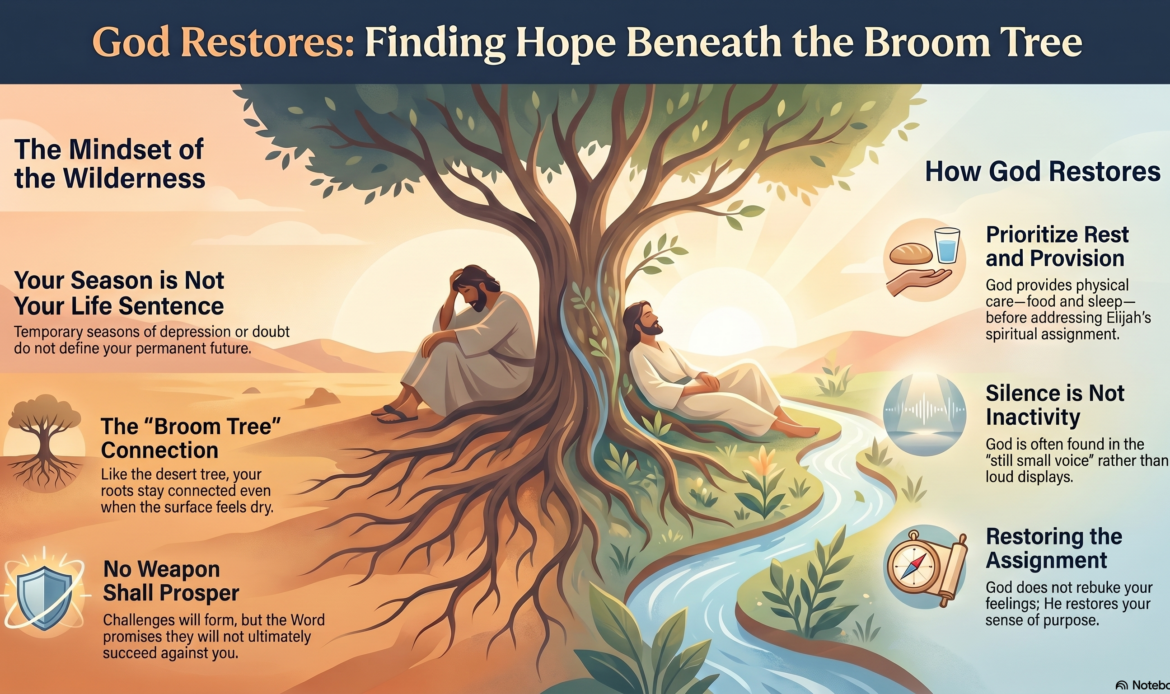
From Breakdown to Breakthrough: 5 Counter-Intuitive Lessons from a Prophet’s Burnout
We have all felt the pull of the “disappearing act.” It’s that heavy, quiet impulse to pull the covers over our heads, silence the phone, and simply opt out of our lives. For many of us—and particularly for men—pain isn’t often expressed through words; it’s expressed through isolation. We don’t talk; we disappear. We hide in our work, our distractions, or a literal wilderness, hoping that if we remain unreachable, the world will stop demanding things we no longer have the strength to give.
Even the most resilient figures in history reached this limit. Consider Elijah, an ancient prophet who had just achieved a staggering victory on Mount Carmel. He had stood before kings and called down fire from heaven, yet moments later, he was running for his life, collapsing in the desert, and praying for it all to end. Elijah wasn’t a distant, unshakeable hero; he was a man in the throes of a profound psychological breakdown. His journey from a desert broom tree to a restored purpose offers a masterclass in how to navigate the wilderness of the human soul.
Your Current Season is Not Your Life Sentence
When we are in the middle of a crisis, we often lose our perspective on time. We mistake a “season of flight” or a “season of doubt” for a permanent state of being. Elijah was so overwhelmed by a threat to his life that he believed his story was over. However, the first step in spiritual and emotional resilience is recognizing that your current struggle has an expiration date.
A critical part of this resilience is what we might call “mental health stewardship.” We have a responsibility to steward the health of our minds, because if we don’t, we inevitably begin to “bleed on the people we lead.” Elijah, meant to be a leader for his nation, was instead found running away because he had reached a point where he could no longer manage the weight of his own trauma. Restoration begins when we realize that while the “weapon” of our current season has formed, its power to define our future is limited.
“The Bible doesn’t say that the weapons won’t form. The Bible says that it ain’t going to prosper… Your season is not your life sentence.”
Why God Prescribes Rest and Bread Before Rebukes
One of the most striking elements of Elijah’s restoration is God’s refusal to lecture him. When Elijah reached his breaking point under the broom tree, God did not start with a theological rebuke or a sermon on faith. Instead, he prescribed a “time out.” God recognized that Elijah’s spiritual exhaustion was inextricably linked to his physical frailty.
The “Angel of the Lord” focused on the most basic human needs—sustenance and sleep—as the necessary prerequisites for emotional healing. The angel provided a specific menu designed for a man who had nothing left:
- Eat: A cake baked on hot stones.
- Drink: A jar of water.
- Sleep: Much-needed rest, repeated twice to ensure full recovery.
Before God addressed Elijah’s heart or his assignment, He addressed his biology. It is a powerful reminder that sometimes the most spiritual thing you can do is take a nap and eat a meal.
The “Underground” Faith of the Broom Tree
Elijah’s collapse occurred under a broom tree, a detail that serves as a profound metaphor for survival. This particular wilderness was one of Elijah’s “own making”—unlike previous times when God led him to water, here he had run of his own accord out of fear. Yet, even in a wilderness we create for ourselves, the broom tree teaches us about “life underground.”
The broom tree survives the harshest desert climates because its roots reach deep into the earth, tapping into water sources far beneath the parched, unrecognizable surface.
- Life Underground: Even when the surface of your life looks dry, unrecognizable, or dead, it does not mean your connection to the Source is severed.
- Deep Connection: Your feelings and perspectives may change, but the roots of your faith can still reach the “water” of God’s presence beneath the fatigue.
Just because the surface of your life is barren doesn’t mean the root is dead.
Silence is Not Inactivity
Upon reaching Mount Horeb, Elijah sought an encounter with God. He witnessed a series of terrifying, loud displays of power—the kind of “spectacle” he had grown accustomed to. However, Elijah’s reaction to these displays was different this time. Having just come from the hype and fire of Carmel, only to be met with a death threat, Elijah could no longer find comfort in the loud and the dramatic. He needed something deeper than a show of force.
The Spectacle (The Hype) | The Source (The Presence) |
A great and strong wind | Not in the wind |
A violent earthquake | Not in the earthquake |
A scorching fire | Not in the fire |
Result: Association with past trauma and hype | Result: Re-entry into the presence of God |
God appeared not in the spectacle, but in the “still small voice.” This reminds us that God’s silence is not the same as His inactivity. Often, we expect a loud, dramatic intervention to solve our burnout, but restoration is frequently found in the quiet moments where God speaks to our hearts once the noise of the crisis has subsided.
Failure Does Not Cancel Your Assignment
The conclusion of Elijah’s journey in the cave is a redirection, not a dismissal. After listening to Elijah’s complaints and his feelings of being the “only one left,” God’s response was simple: “Get up and go back.”
God did not rebuke Elijah for his feelings of being overwhelmed. Instead, He restored Elijah’s assignment. In our darkest moments, we often pray for an exit, but sometimes we should thank God for saying “no” to our desire to quit. God’s “no” to Elijah’s request for death was actually a “yes” to his purpose. A stumble or a period of hiding does not change the calling on your life. Restoration is evidenced by the fact that God trusts you to go back and finish what He started.
“God does not rebuke Elijah’s feelings. He restores his assignment.”
——————————————————————————–
The story of the prophet’s burnout ends not in the isolation of a cave, but with a return to the world. When you find yourself in your own “wilderness,” remember that God is not finished with you, even when you feel finished with yourself.
What are you doing here?