
Sermon Title: Who Pushed Me | Speaker: Ps. Wallin O’Connor
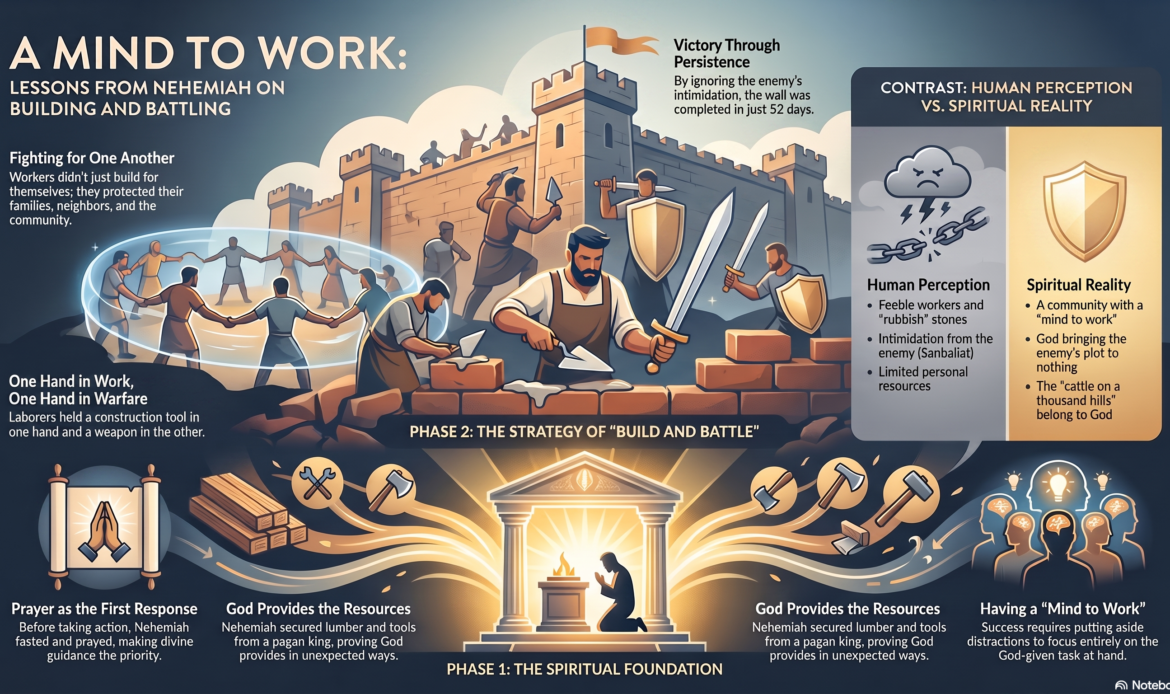
Beyond the Rubbish: 5 Radical Lessons on Rebuilding in a Polluted World
1. The Smoke in the Air and the Gaps in the Wall
Lately, the air has felt heavy—and not just because of the summer humidity. Between the forest fires raging across Northern Ontario and the thick haze drifting across our borders, there is a literal and metaphorical “smoke” choking our communities. While social media feeds are filled with people having a “hissy fit” over the poor air quality, the deeper tragedy often goes unnoticed: those fires are currently gutting Native reserve lands, displacing families whose stories rarely make the evening news.
This is the modern social haze. It is a world where we are easily “feeble”—overwhelmed by displacement, exhausted by environmental toxicity, and paralyzed by the sheer volume of “rubbish” piled up in our communal spaces. When the walls of our social and spiritual lives are in shambles, we need more than just a fresh breeze; we need the “Nehemiah mindset.” This radical approach to restoration isn’t about having a massive bank account or waiting for perfect conditions; it’s about learning how to build when the air is thick and the critics are loud.
2. Practical Ministry: Why Your “Doctrine” Might Be Getting in the Way
The greatest threat to modern community building is “spiritual obesity.” We have become a culture that consumes endless amounts of truth, data, and doctrine, yet we do nothing to exercise our faith. We sit in our pews or behind our screens, growing heavy with knowledge while the world outside remains broken.
In a skeptical, post-religious society, leading with a lecture is a guaranteed failure. To rebuild effectively, we must adopt “Christ’s Method,” which disrupts the traditional “doctrine-first” bureaucracy. This method demands that we meet physical needs—food distribution, clothing, and active listening—before we ever open a book of rules. Relationship must precede regulations. If your character doesn’t reflect a different way of living, your neighbor won’t care about the truth of your beliefs. In the workplace or the neighborhood, your refusal to participate in underhand business dealings is a louder witness than any sermon.
“You may be the only Jesus some people will ever see.”
3. The Psychology of “A Mind to Work”
Nehemiah 4:6 tells us the wall was joined together because “the people had a mind to work.” This is a psychological masterstroke. Having a “mind to work” means intentionally putting aside every avenue of foolishness and focusing entirely on the task at hand.
The moment you start clearing the “rubbish,” you will attract the “Sanballats and Tobiahs”—the sideline critics who mock your progress. They will joke that your efforts are so flimsy a single fox could knock down your stone wall. The radical response is not a counter-argument; it is silence. Nothing irritates a critic more than continued progress. By refusing to engage in fruitless character battles, you preserve your energy for the construction. The work is the focal point; the noise is a distraction.
4. Divine Resourcefulness: Using “Pagan” Tools for Sacred Goals
We often stop building because we look at our own bank accounts and see “minimal resources.” Nehemiah didn’t have this luxury. He was a cupbearer for King Artaxerxes—a secular, pagan ruler. This was not a casual job; Nehemiah literally held the King’s life in his hands, tasting every drink to ensure it wasn’t poisoned. It was this high-stakes professional relationship, built on secular trust, that God used to fund the sacred work.
When you realize that “You plus God is always the majority,” your perspective on lack shifts. Sometimes, God-sized goals require God-sized boldness. I think of the story from the Alberta conference where the leadership actually locked the doors and challenged the congregation to stop being “devils at home” while neglecting the field. They aimed for $50,000 and walked away with $350,000.
Consider these three ways to view your resources:
- Don’t look at what you lack; look at who owns the “cattle on a thousand hills.” God doesn’t need your wealth; He needs your availability.
- Fly low and keep plans quiet. Nehemiah surveyed the damage at night. Not every vision needs to be broadcast before the authority and resources are secured.
- Expect resources to come from unexpected, secular sources. God can move the heart of a “pagan” king to provide the lumber for your sanctuary.
5. The Two-Handed Approach: Trowels and Swords
Nehemiah 4:17 gives us a striking image of the builder: a tool in one hand and a weapon in the other. Survival during a rebuilding phase requires this “two-handed” approach. However, the “sword” in your hand is not for attacking the person standing next to you on the wall.
The sword is the “Sword of the Spirit”—the Word used to fight off the internal forces of discouragement and the external confusion of the enemy. No one rebuilds a wall alone; this is a “prayer partner” system. While one person is laying stones with a trowel, the other is “fighting on their knees.” We are not just building a structure; we are fighting for our sons, our daughters, our wives, and our houses. This domestic urgency should drive our labor. When one of us grows weary, the other must pick up the sword and stand watch.
6. Conclusion: The 52-Day Challenge
The radical lesson of Nehemiah’s wall is that unity and focus can compress time. What critics expect to take decades can be accomplished in 52 days when a community is galvanized.
But we must remember the process. Just as our spiritual preparation in prayer is the “Julie mango”—the sweet, necessary labor of the early season—the final restoration of our community is the “East Indian mango” we get to enjoy together in the end. We are not building for our own comfort or to sit in “mansions of ease” while the air remains toxic for others. We are building because the work itself is the testimony.
“The work is the focal point of the story, not the builder.”
What “rubbish” in your life or community is waiting to be cleared, and who is standing next to you with a trowel?