

Evening Program | Speaker: Ps. Mitchum Burnett
- Sermon By: Mitchum Burnett
- Categories: Youth Evangelistic Series - 2026
Why Your Biggest “Refresh” Might Come from the Most Unlikely Place
In the modern office, there is a specific kind of silence that descends the moment the internet goes down. It starts with a collective sigh, followed by the frantic clicking of mice, and finally, a room full of people leaning back in their chairs with a mix of frustration and secret relief. The “system is down.” It’s a catastrophe that apparently requires a high-level intervention, so we call Rick, the IT professional. We sit and watch the reboot percentage climb on the screen, assuming Rick is performing some form of digital sorcery to save the network.
Yet, as Rick will tell you, the solution is often embarrassingly low-tech. After hours of downtime and dozens of people sitting idle, he’ll walk in, realize a cord was kicked loose or the system just needed a hard restart, and—click—everything is back to normal. We expected a nineteen-million-point overhaul; God offered a simple reboot.
This IT drama is a perfect window into our spiritual lives. We often find ourselves stalled, waiting for an extravagant, complicated plan to fix our “stale” routines. But the ancient story of the four lepers in 2 Kings 7 suggests that our greatest breakthroughs don’t come from complexity, but from the willingness to hit the “refresh” button and move.
The “Control-F5” Principle: The Power of a Simple Restart
In web browsing, “Control-F5” is the command for a hard refresh. It doesn’t just reload the page; it clears out the old, cached data to make way for the current reality. Spiritual renewal works the same way. It’s not a grueling marathon; it’s a simple, three-part cycle: Confess, Restart, and Move Forward.
We often resist this because we’ve been taught that significant change must be difficult. We assume that if we feel “mundane” in our faith, we need to go on a mountain retreat or read a library of theology. But sometimes, the “system” just needs to be turned off and on again.
“God doesn’t have this extravagant 19-million-point plan for you to refresh. He’s got a simple thing: Confess, restart, move forward.”
Stop Acting Like a Leper: Rejecting the Identity of Rejection
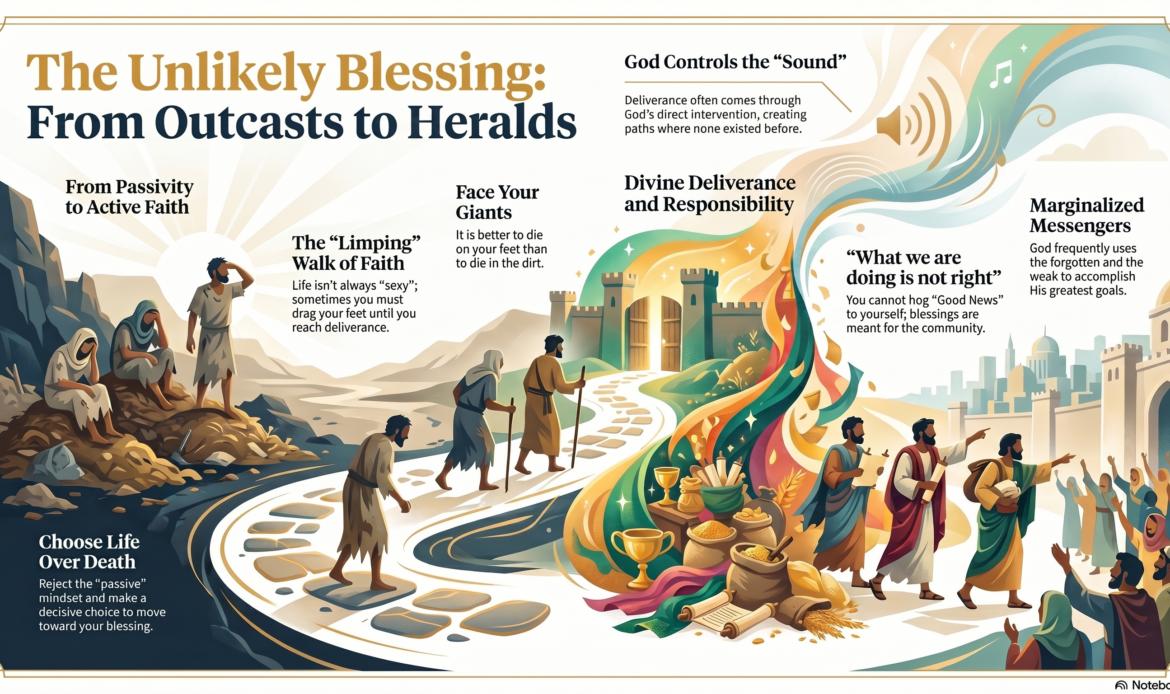
In the biblical narrative, we find four men with leprosy sitting at the entrance of the city gate. In their world, they were the “dung heap of society,” marginalized outcasts required to shout “Unclean!” to warn others of their presence. They were excluded from every “barbecue,” every social gathering, and every safety net. But the real tragedy wasn’t just their disease; it was that they had accepted the identity society gave them. They lived like they were rejected because they believed they were rejected.
This leads to a visceral question for us today: Do you believe you are a leper?
Many of us carry an “identity of rejection” into rooms where God has already invited us. This mindset manifests in our daily rituals. When you believe you are worthy of the life God has promised, you care for yourself differently. You start using different soap. You don’t just settle for the basic Vaseline; you go find the “Almond Jurgens.” You press your clothes. You realize that your value isn’t dictated by the “WhatsApp groups” you’ve been sidelined from or the people who drag your name through the dirt. Choosing life means logging out of the toxic groups and deciding that if you’re going to go down, you’re going down swinging.
“It’s better to die on your feet than to die in the dirt.”
The Auditory Illusion: Why We Fear What We’ve Created
The turning point in the story occurs when God intervenes using an “auditory illusion.” He caused the opposing Aramean army to hear the thunderous sound of chariots and horses, a force so massive they abandoned their tents, horses, and gold to flee for their lives. They were paralyzed by the fear of an army that didn’t exist.
We suffer from these same illusions. I remember being terrified of the dark as a child, convinced a monster was lurking in the closet. When my mother finally burst in and flipped the light switch, the “monster” was revealed: it was just my own dirty shoes on the floor and a pile of my own clothes in the closet.
I wasn’t afraid of a demon; I was afraid of the “dirt that I had dragged into my own room.” We often cower at sounds that go “bump in the night”—the fear of a neighbor’s silence, a bank teller’s look, or a storm that hasn’t even formed—not realizing we are paralyzed by the baggage we brought in ourselves. God wants to use that same sound to chase away your enemies, if you’d only stop hiding from it.
“God used a sound to paralyze the enemy with fear who had used fear to paralyze his people.”
The “Basera” Principle: The Oxtail Paradox
When the lepers reached the abandoned camp, they found a literal gold mine. After gorging themselves, they had an epiphany: “This is a day of good news, and we are keeping it to ourselves.” The Hebrew word here is Basera, meaning “Good News” or “Gospel.”
In our world, sharing usually means losing. If a visiting pastor has a plate of rice and peas or oxtail, he might be hesitant to share his curry goat because if he gives you some, he has less. But the “Basera” of God is a paradox: in the economy of the Gospel, sharing leads to gaining. When we “evangelize” rather than “capitalize” or “fossilize,” the blessing multiplies.
God has always used “marginalized messengers” to deliver this news, proving that your pedigree doesn’t matter as much as your willingness to speak:
- The Shepherds: Unrefined laborers who were the first to announce the King.
- The Wise Men: Eastern outsiders who weren’t even part of the “inner circle.”
- Mary Magdalene: A woman with a history the “righteous” couldn’t look past.
- Peter: A foul-mouthed fisherman with a temper and a weapon.
The Pegasus Effect: The Upgrade of Inconvenience
Consider the irony of a cancelled flight. Imagine standing in the Norman Manley Airport in Jamaica, a broke student with just enough cash for the taxi that already dropped you off. You’re holding an economy ticket for a flight that no longer exists.
The scene turns from “professionalism to Jamaicanism” as the staff deals with angry travelers—like the New Yorker with dreads trying to use “broken Patois” to demand a new flight. When it’s your turn, they tell you they tried to call you at a “514” number, but your number is “876.” Communication has failed. You are stranded. It feels like a disaster.
But because the airline—not you—is now responsible for the “inconvenience,” the disaster becomes a doorway. Suddenly, you aren’t a broke student; you’re a guest at the Pegasus Hotel with vouchers for food and taxis. When you return the next morning, you aren’t in economy anymore; you’ve been upgraded to a class where the bags come off first and they give you warm towelettes. We spend so much time counting the woes in our pockets that we forget to count the God in heaven who uses setbacks to reposition us for a first-class blessing.
“Sometimes an unexpected blessing is right in front of us but we don’t know because we count the money in our pockets and not the God in heaven.”
Conclusion: A Pep in Your Step
The most profound detail of the lepers’ story is often the most overlooked: the Bible doesn’t say they were healed before they found the camp. They were likely still sick, still marginalized, and still limping when they stumbled upon the gold. They found the blessing while they were still in their condition.
If you believe God has delivered you, you have to start acting like it before the evidence shows up. When you realize your “account” has been filled by His grace, it puts a “pep in your step.” You walk differently, you talk differently, and you stop arguing over “which Bible version is better” and start telling people what Jesus did for you on Thursday.
What “gate” are you sitting in front of today? Stop waiting for the leprosy to disappear before you start walking toward the camp. The refresh you need is just one “restart” away. Don’t die in the dirt when there is a feast waiting just past the sound of your fears.