
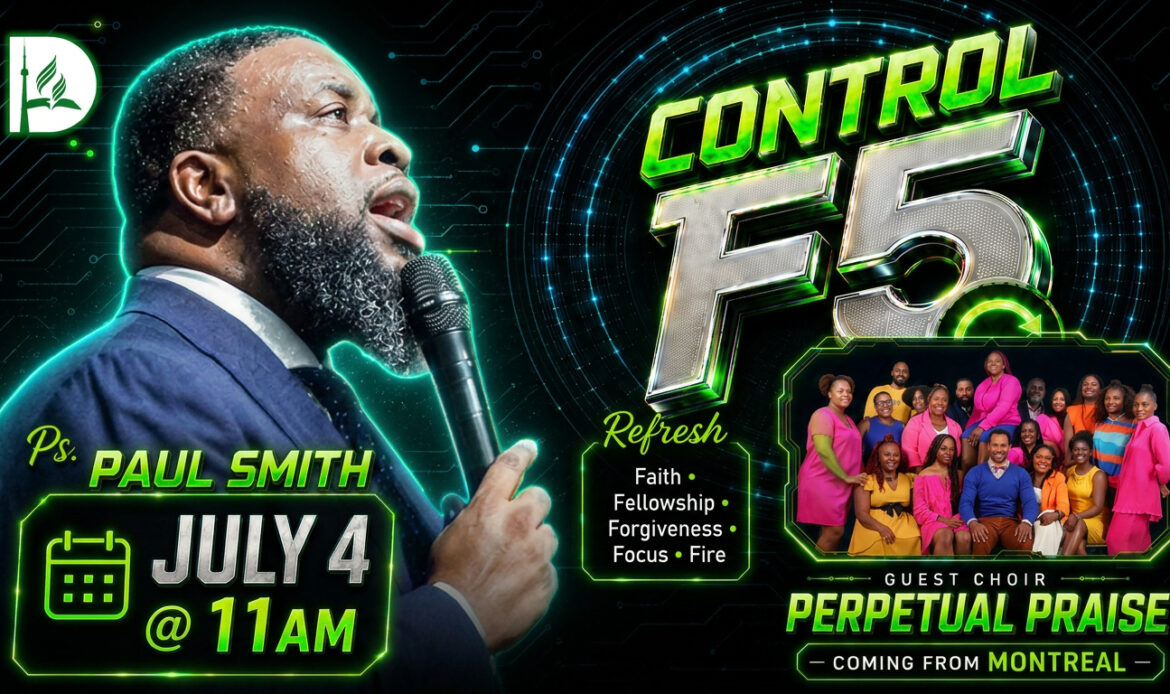
Week #3 – Control F5-Youth Evangelistic Series | Sermon Title: “I’m Not Finished” | Speaker: Ps. Paul Smith
- Sermon By: Paul Smith
- Categories: Youth Evangelistic Series - 2026
Wounded Worship: Why Your Deepest Scars Are the Keys to Your Greatest Breakthrough
The Notification We All Ignore
We’ve all seen it. You’re in the middle of a busy day, scrolling through your life, when that persistent notification pops up on your screen. If you’ve ever owned a Samsung Galaxy 9, the message is specific: “You have not restarted your phone in seven days.”
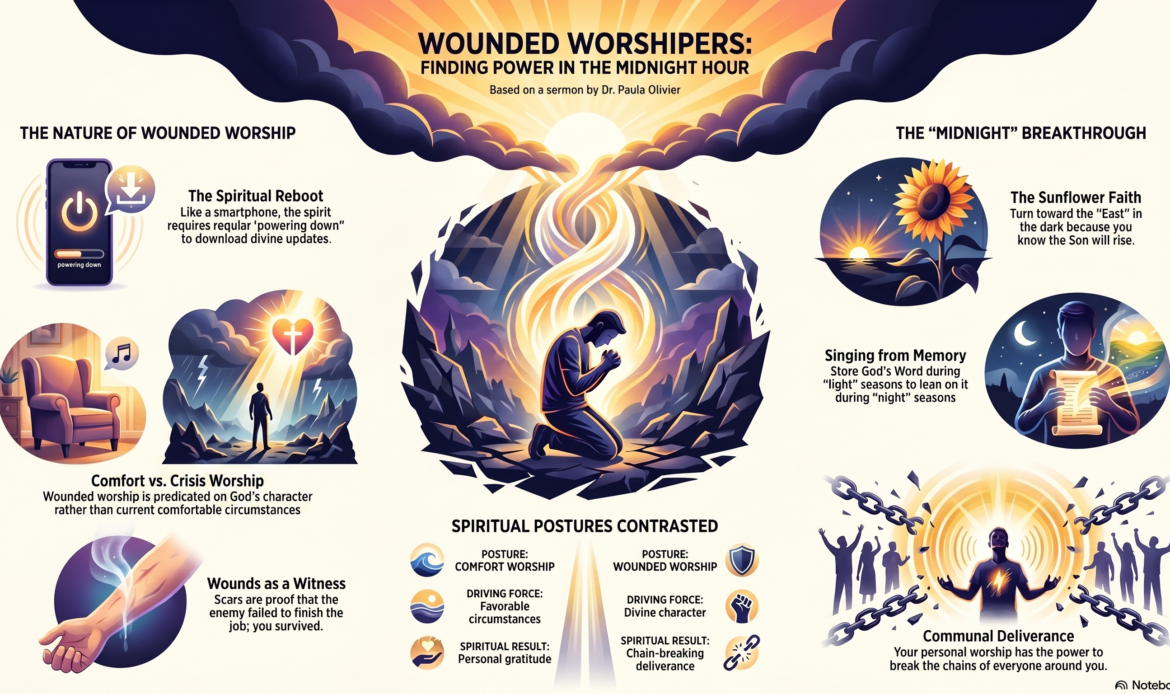
Most of us dismiss it. We keep pushing, ignoring the fact that the system is lagging. But that “7-day restart” isn’t just a suggestion; it’s a technical necessity to clear the glitches that accumulate through constant use. Dr. Paula Olivier recently shared a transformative truth: your soul operates on the same frequency. If you don’t power down to reboot, the “glitches” of life—the stress, the hurt, and the exhaustion—will keep you from your optimal performance. We need a spiritual reboot, and it happens through worship. But here is the crux: the most powerful reboot doesn’t happen when you’re “fully charged.” It happens when you are wounded.
The Seven-Day Reboot: Why Weekly Worship is Non-Negotiable
Worship is far more than a religious ritual; it is a functional “power-down” from the noise of the world so you can “power-up” with the Divine. In the economy of God, the Sabbath and the weekly gathering are the charging stations for the soul.
Dr. Olivier breaks down the three-fold blessing of this spiritual restart:
- Downloading Spiritual Updates: You cannot receive “fresh oil” while your system is cluttered with last week’s drama. Rebooting opens the bandwidth to hear God clearly.
- Allowing Updates to Take Hold: When you stop your labor, the truths you’ve heard throughout the week finally integrate into your character.
- Achieving Optimal Performance: By refreshing your focus on Christ, you ensure that you aren’t just running; you’re running well.
The Trap of Projection: Recognizing “Small Minds”
In Acts 16, we see Paul and Silas being followed by a “damsel” who seemingly spoke the truth, but with a mocking spirit. This is a classic case of projection and gaslighting. Often, people will project their own dysfunctions and insecurities onto you. They assume you are in competition with them when you are really just trying to fulfill your destiny.
To navigate these “gaslighting manipulators,” you must recognize the hierarchy of perspective:
- Great Minds: Discuss ideas and purpose.
- Average Minds: Discuss events and happenings.
- Small Minds: Discuss people and gossip.
If you are a great mind, you cannot allow a small mind to dictate your worth. As Dr. Olivier powerfully declares regarding those who disrespect your journey:
“I’d rather adjust my life to your absence than adjust my boundaries to accept your disrespect.”
The Trigger Word: Why “Slave” Changed Everything
The Bible says the damsel called them “servants,” but the original Greek word is douloy—which literally means slave. For Paul, this was a “trigger word.” It was a mocking attempt to paint them with the same brush of bondage she carried.
Think of the movie Hancock, where the heroes have a “trigger word” that makes them go berserk. When that damsel called Paul a slave one too many times, something shifted. Paul didn’t just get annoyed; he went “berserk” in divine authority. He turned around and commanded the spirit to come out in the name of Jesus. There was an immediate eviction. When divine authority shows up, there is no discussion, no negotiation, and absolutely no back-talk. The enemy has to pack up and get out the same hour.
The Midnight Advantage: Relying on the “Stored Word”
After their victory, Paul and Silas were beaten and thrown into the “inner prison”—the darkest, deepest part of the dungeon. It was midnight. They were bleeding, their feet were fast in the stocks, and it was pitch black.
Here is the “Midnight Advantage”: They couldn’t read a Bible in the dark. They couldn’t pull out a hymnal. They had to lean on what they had stored up when the sun was shining. They didn’t need a page because they had the promise; they didn’t need to see the words because they were soaked in the Word. You must hide the Word in your heart during your “sunny seasons” so that when the night comes, you don’t have to go searching for a promise—you can just start singing it.
The Sunflower Philosophy: Anticipating the Rise
The sunflower is a marvel of resilience. It isn’t named for its yellow petals, but for its movement (heliotropism). It follows the sun all day, but notice what happens at night: the sunflower doesn’t stay turned toward the West, mourning the sunset. In the middle of the night—while it is still dark—the sunflower turns itself back toward the East. It moves in anticipation because it knows the sun will rise again.
Sunflower Worshiper: A believer who moves toward God’s promises based on His character rather than their current comfort or location.
Wounded Worship is worship offered while the back is still bleeding and the heart is still breaking. It is the choice to turn East while you’re still in the midnight of the inner prison.
The Rippling Effect: Your Deliverance is Not Just for You
The enemy made a colossal mistake in Acts 16. He didn’t just put Paul in prison; he put Paul and Silas in the same cell. My Bible says that where two or three are gathered, God is in the midst. Putting two worshipers in the same dark place was an invitation for an earthquake.
But notice the “Collective Deliverance”: Paul and Silas were the only ones praying and praising, yet everyone’s chains fell off and all the doors flew open. Your worship in the midst of your wound is a partnership with the miraculous. Your decision to praise in the “inner prison” of your life is breaking the chains of your children, your spouse, and the fellow “prisoners” in your circle. Someone is being delivered right now because of “grandma’s prayers” and your “wounded worship.”
Conclusion: Will You Worship Anyway?
There is “Comfort Worship,” which praises God when the bills are paid and the body is well. Then there is “Wound Worship,” which lifts its hands when the spirit is crushed. Dr. Olivier reminds us that your scars are not signs of defeat; they are medals of survival.
If you are in a night season, don’t let the darkness paralyze you. Be the sunflower. Turn toward the East. Anticipate the rise. Because your shout in the middle of the pain is the very thing that shakes the foundations of your prison.
“Your wound did not stop your worship; your wound shaped your worship. Your wound is not your weakness; it is your witness.”