
Week #4 – Control F5-Youth Evangelistic Series | Sermon Title: “Who Pushed Me” | Speaker: Dr. Lyle Notice
- Sermon By: Dr. Lyle Notice
- Categories: Youth Evangelistic Series - 2026
The Billionaire, the Alligator, and the Grace of the “Push”: Lessons from Bethesda
The Seduction of Stagnation
We have all felt the strange gravity of a situation that no longer serves us. Perhaps it is a career that has hit a glass ceiling, a relationship that has devolved into a cycle of mutual exhaustion, or a spiritual life that feels like it’s stuck in neutral. There is a curious, almost seductive comfort in the familiar, even when the familiar is dysfunctional. We tell ourselves we are waiting for a sign, a shift in the wind, or a helping hand, yet we remain rooted in the same spots, paralyzed by a cocktail of fear and habit.
In the Gospel of John, we encounter the Pool of Bethesda—a place where the “blind, lame, and paralyzed” gathered under five porches, waiting for a supernatural stirring of the water. This isn’t just a historical setting; it is a visceral metaphor for modern-day stagnation. It is a place of perpetual waiting, surrounded by a community where immobility is the norm and the hope for change has been replaced by the routine of suffering.
The following insights are distilled from Dr. Lyle Notice’s provocative sermon, “Who Pushed Me.” By dissecting the encounter between Jesus and a man paralyzed for 38 years, Dr. Notice challenges us to reconsider the mechanics of a breakthrough. He suggests that the very “push” we spend our lives trying to avoid is often the singular grace required to move us into our potential.
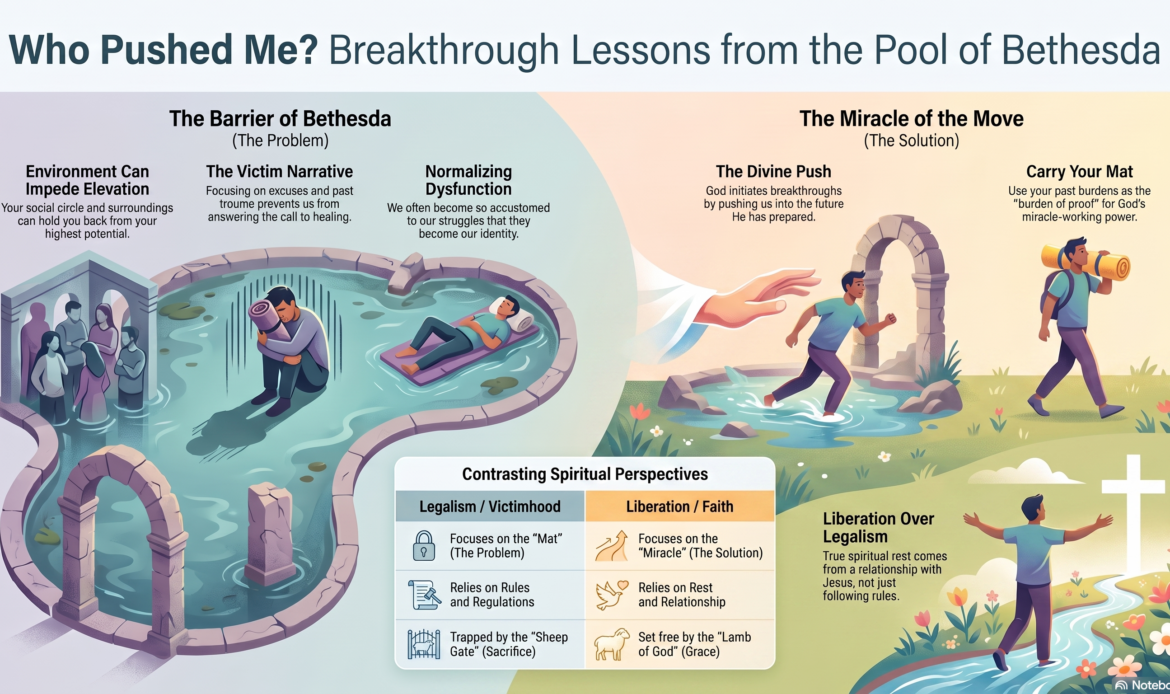
Takeaway 1: The Sovereignty of the “Push”
Dr. Notice illustrates human inertia through the story of a billionaire who invited guests to his massive estate. Standing before a large infinity pool teeming with alligators, the billionaire made an offer: “Anyone brave enough to swim across, I will give you anything you want.” Silence gripped the crowd until, suddenly, a man was in the water, thrashing and flailing in a desperate sprint to the other side. As he climbed out, dripping and gasping, the billionaire praised his immense courage. The man’s only response? “I just want to know who pushed me.”
The reality of the human condition is that, left to our own devices, we rarely choose the risk necessary for a leap of faith. We prefer the safety of the pool’s edge, even if it means staying stagnant. We must recognize that God often initiates a “push”—a crisis, a sudden depletion of resources, or a jarring change in circumstances—to propel us toward a promise we would never have pursued voluntarily. Dr. Notice reminds us that “deliverance does not come before depletion.” God often empties us of our self-reliance so that the only way forward is through His intervention.
“Sometimes left up to your own devices you wouldn’t do it and so what God does is he pushes you.”
Takeaway 2: Environment as an Elevation Ceiling
The environment at Bethesda was toxic precisely because it was comfortable. Surrounded by those who were equally “jacked up,” the paralyzed man found a place where his dysfunction didn’t seem out of place. Dr. Notice warns that your surroundings act as a ceiling to your potential. He leans into a sharp, modern metric: your bank account and your character are often a reflection of the top five people you spend the most time with.
If your “birds of a feather” are all content to stay on their mats, it becomes nearly impossible for you to find the will to stand. Elevation requires a change in atmosphere. To move toward where God is taking you, you must have the courage to acknowledge when your current circle is holding you back. Not everyone who is with you is meant to go with you.
“Your environment can impede your elevation.”
Takeaway 3: Dismantling the Narrative of the Victim
When Jesus approaches the man at the pool, He asks a question that sounds almost clinical: “Do you want to be healed?” The man’s response is revealing. Instead of a resounding “Yes,” he offers a list of excuses: “I have no man to put me in the pool… another steps down before me.”
This interaction highlights the danger of the “victim narrative.” After 38 years, the man had become so married to his story of neglect and bad luck that it was the first thing he reached for when faced with a miracle. Dr. Notice challenges us to “check the story you keep telling yourself.” Until you stop blaming your past, your lineage, or the people who “got in front of you,” you cannot embrace the command to “Rise.” Breakthrough requires shifting from a narrative of victimization to a narrative of radical responsibility.
Takeaway 4: The Paradox of the Mat
After the healing, Jesus gives a curious command: “Take up your bed and walk.” Later, when religious leaders confronted the man, they weren’t celebrating his 38-year recovery; they were incensed that he was carrying his mat on the Sabbath. They were more concerned with a policy violation than a person’s restoration.
The “mat” represents our coping mechanisms—the things we once depended on to survive our dysfunction. Dr. Notice explains that while we are no longer called to lie on the mat, we are often called to “carry it” as evidence. The mat is the burden of proof that God still operates as a miracle worker. It is a reminder of where you used to be, and it serves as a testimony to others. However, you must be discerning: surround yourself with people who celebrate your miracle, not those who are fixated on your past “mat.”
“Be careful of people who are more concerned with your mat than your miracle.”
Takeaway 5: Sabbath as Liberation, Not Bondage
Dr. Notice offers a vital theological correction for those raised in rigid religious traditions. He reclaims the Sabbath from the hands of the legalists by outlining three distinctions:
- Liberation, Not Legalism: The Sabbath is designed to free us from work and the grind of consumerism, not to bind us with new regulations.
- Rest, Not Rules: It is a sanctuary in time for relationship with God and others, not a checklist for perfection.
- A Sign, Not a Savior: The Sabbath is a symbol of our identity as followers of God, but it does not save us.
This shift is counter-intuitive because we are conditioned to believe we must work for our standing. Understanding the Sabbath as liberation allows us to focus on the Healer rather than the “mat” of our own efforts.
Conclusion: The GPS of Grace at the Sheep Gate
The story of Bethesda concludes with a beautiful symmetry: the Bible records that Jesus later “finds” the man in the temple. This is the “GPS of Grace.” Jesus saw the man in his sin-fallen state to heal him, and He tracked him down in the temple to restore him to the community.
Dr. Notice links this to a powerful “paid forward” moment. As a young, broke pastor, he stood at a bookstore counter with a stack of commentaries, sweating bullets because he knew his bank account was empty. Just as he was about to hand over his card, expecting a humiliating decline, the clerk stopped him. “It’s been paid forward,” she said. Two elderly women he had been kind to earlier had covered his entire balance. “And take a cookie,” she added, “the cookies are free.”
This is the theology of the Sheep Gate. The Pool of Bethesda sat right next to where the sacrificial lambs were brought into the temple. The paralyzed man was at the place of sacrifice, but he had no money to buy a lamb and no strength to offer one. He had nothing—just as Dr. Notice had nothing at that bookstore counter. But he was talking to the Lamb of God.
Grace is the reality that when we lack the currency to pay our way or the strength to heal ourselves, Jesus covers the deficit. He is the sacrifice that was paid forward before we even reached the counter.
Reflective Question: What “mat” of past trauma or habit are you still lying on today? Are you willing to stop telling the story of why you’re stuck and accept the “push” of grace that is moving you toward your future?